Universe Theories, From the Big Bang to the Dark Forest
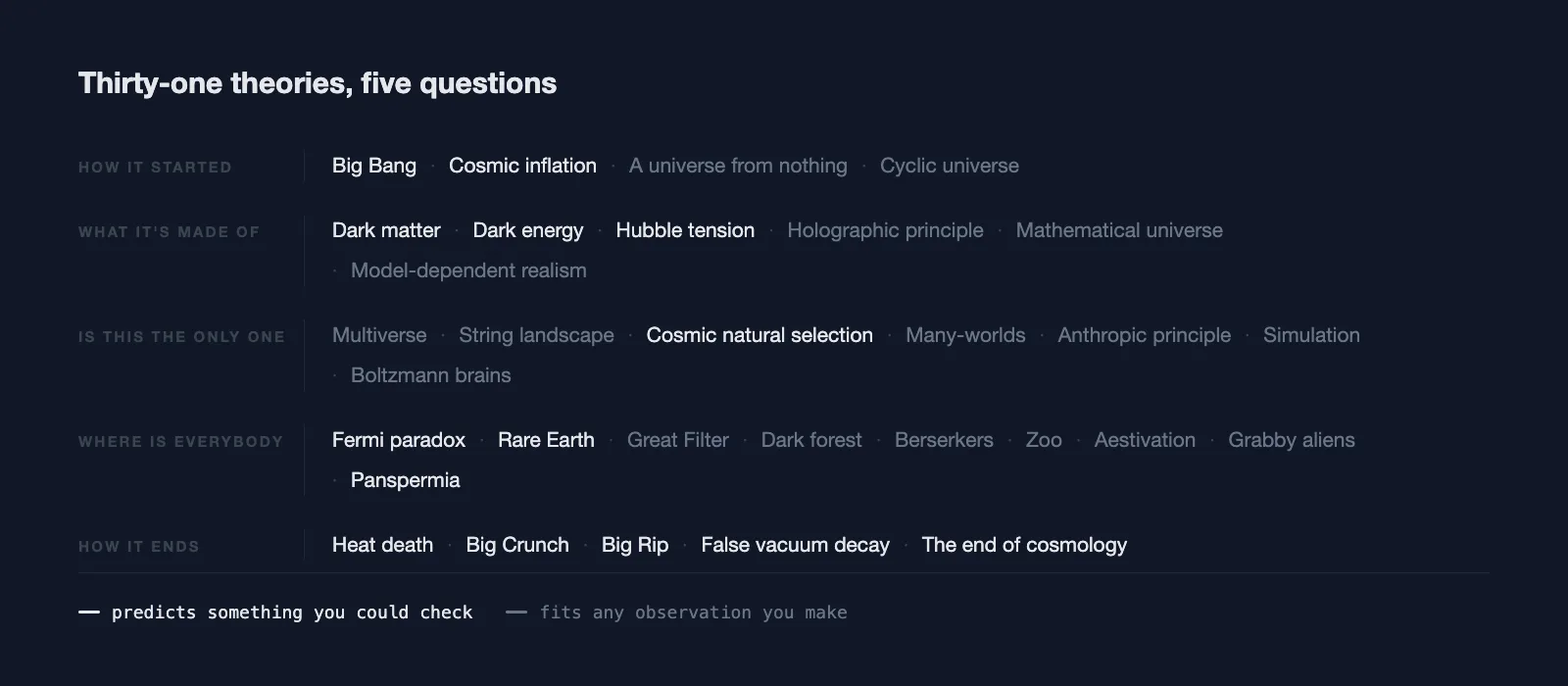
Thirty-one ideas about how the universe began, what it is made of, whether it is the only one, why space looks empty, and how it ends.
I read The Grand Design recently. It's Hawking and Mlodinow making the case that the universe doesn't need a creator. Gravity and quantum mechanics are enough to get one started on its own, there are probably an enormous number of them running different physics, and we're in this one because we couldn't have turned up in a universe that doesn't allow people.
The argument is fine. What I didn't expect was how much is packed into it. Almost every sentence leans on something with its own name and its own long-running fight attached, and I'd go to look one up and find three more sitting behind it.
So I started writing them down. That's what this is.
How it started
The Big Bang
Around 13.8 billion years ago the universe was hot and dense, and it's been expanding ever since. Nothing else here has anything like the same evidence behind it. Worth clearing up the usual misreading though: it wasn't an explosion that went off somewhere in space. Space itself expanded, everywhere at once, and it still is. Distant galaxies show a redshift in proportion to how far away they are. The leftover heat of the early universe still turns up wherever you point a dish. The hydrogen and helium we actually see match what the model says there should be. Those three arrived from completely different directions and landed in the same place.
Cosmic inflation
Two things about the sky didn't add up. Patches on opposite sides of us sit at the same temperature despite never having been in contact, and space is flat when nothing obliged it to be. Guth's fix in 1980 was to say that in the first sliver of a second, space expanded by a factor of at least , which puts everything we can see today inside one small patch that had been in touch before the stretch. Almost everyone thinks something like this happened. Nobody can tell you what caused it.
The universe from nothing
This is the part of The Grand Design that got the headlines. Gravitational energy is negative, matter energy is positive, and in a closed universe the two can cancel out to zero. Nothing with a total energy of zero has to be paid for, so a universe can turn up as a quantum event without breaking any conservation law. Hawking's line is that "because there is a law such as gravity, the universe can and will create itself from nothing." The obvious comeback is that a nothing which already contains quantum mechanics and a law of gravity isn't nothing. Nobody has really answered that one, they've only restated it.
The cyclic universe
Some models give you repeated rounds instead of a single beginning. Penrose's version, conformal cyclic cosmology, is the strangest of them. At the far end of heat death nothing with mass is left, and without mass you can't build a clock or a ruler. If nothing can measure scale, a cold empty infinity and a hot dense point are the same object mathematically. So the end doesn't lead to a new beginning on that reading. It's the same thing described twice.
What it's made of
Dark matter
Galaxies spin too fast at their edges to hold together on the mass we can see, and clusters bend passing light more than their visible contents should. The usual reading is that there's about five times more matter out there than the sort that shines. Zwicky suggested it in the 1930s, Rubin's rotation curves made it hard to dismiss in the 1970s, and forty years of increasingly sensitive detectors have still turned up nothing directly.
Dark energy
Expansion is speeding up, and gravity doesn't do that. Dark energy is the name for whatever is behind it, and on the standard accounting it comes to about 68% of everything there is. This is the entry most likely to look different in ten years. DESI's second data release in 2025 found the numbers fit better if dark energy has been fading over time rather than sitting constant, somewhere between 2.5 and 3.9 sigma depending on which supernova set you fold in. Interesting, not settled. But if it holds, some of the endings below trade places.
The Hubble tension
There are two good ways to measure how fast the universe is expanding and they don't agree. Watching nearby stars and supernovae gives about 73 kilometers per second per megaparsec. Reading it off the leftover heat of the early universe gives about 67. Both methods have been sharpened for years and the gap has only hardened, past five sigma now, which is far too big to be bad luck. The obvious escape was that crowded star fields were fooling the local measurement, and JWST shut that door at eight sigma. So either there's a subtle error nobody can find, or the standard model of cosmology is missing something between the early universe and now.
The holographic principle
A black hole's entropy scales with its surface area rather than its volume, which is odd, because information isn't supposed to behave that way. The principle generalizes it: everything going on inside a region can be described completely by information written on the boundary, one dimension down. Maldacena made this precise in 1997, though for a shape of spacetime that isn't ours, and it has been used heavily ever since. Nobody serious claims we live inside a projection. The claim is that the inside holds no more information than the surface does, which is strange enough on its own.
The mathematical universe
Tegmark takes the unreasonable effectiveness of mathematics at face value. Physics keeps finding that the universe follows mathematics far more exactly than it needs to, and his reading is that it doesn't follow mathematics, it is mathematics. Every self-consistent structure exists in the same sense ours does, and physical existence isn't an extra ingredient sprinkled on one of them. It's clean, it's unfalsifiable, and it gives you the multiverse for free.
Model-dependent realism
The philosophical floor of The Grand Design has aged better than the physics built on top of it. You can't test a model against reality except through another model. So "which picture is really true" is the wrong question, and the one worth asking is which picture predicts more while assuming less. That sounds like a dodge right up until you notice how many arguments on this list are arguments about which picture is really true.
Is this the only one
The multiverse, in four levels
"Multiverse" gets used for four unrelated claims, and Tegmark's taxonomy is the easiest way to keep them apart.
Level I: space goes on forever, so arrangements of matter repeat, and somewhere absurdly far away there's a region identical to this one. Level II: other bubbles that stopped inflating separately from ours, with different constants. Level III: the branches of quantum mechanics, below. Level IV: every mathematical structure, above.
Level I follows from things most physicists already accept. Level IV is close to a religious position. People argue about them as though they were one idea.
The string landscape
String theory doesn't hand you one set of physical constants. It hands you a colossal number of possible vacuum states, with the figure that gets quoted. This began life as an embarrassment, since a theory of everything that permits nearly anything isn't much of a theory. It got reframed as the machinery behind Level II, where it supplies the huge stock of varied universes that the anthropic argument needs to work.
Cosmological natural selection
Smolin's version has black holes giving birth to new universes, each one coming out with slightly different constants. Universes that make plenty of black holes leave more descendants, so after enough rounds you'd expect to find yourself in one that's good at making black holes, which is roughly what ours looks like. He also made a prediction you can go and check, which is rare in this company: the theory caps how heavy a neutron star can get, and finding one above that cap kills it. Vilenkin has argued the selection story doesn't hold together, since you can get more black holes by cranking the cosmological constant instead. Either way it's one of the very few claims in this section that could actually lose.
Many-worlds
Everett published this in 1957. Quantum mechanics says a system holds every possibility at once until it's measured, at which point one outcome shows up. Many-worlds deletes the second half of that sentence. Nothing collapses. The observer gets entangled with the system and ends up in one branch of it, every outcome happens in some branch, and the branches lose the ability to talk to each other. Worth knowing that this isn't a fringe view. It's one of the mainstream interpretations, and some of the appeal is that you get to it by removing a rule instead of adding one.
Fine-tuning and the anthropic principle
Several constants of nature sit in narrow bands, and nudging them gives you no chemistry, no stars, nothing with structure. That's the observation. The anthropic principle is one reply to it: any universe that gets observed has to be one that allows observers, so living in a habitable universe is a selection effect rather than a coincidence. It only does real work if there are many universes to select from. Without them you've got a shrug with a Latin name.
The simulation hypothesis
Bostrom's argument gets misquoted constantly. It's a trilemma. At least one of these has to hold: civilizations reliably die before they can run ancestor simulations, or they get the ability and almost none of them bother, or nearly everyone with experiences like ours is simulated. Throw out the first two and the third follows by counting heads. Everything downstream of that, the hunt for glitches and pixel sizes and rendering shortcuts, is decoration. There's no accepted test.
Boltzmann brains
Nobody proposes this one. It turns up uninvited. Given long enough, random fluctuation produces anything that can happen at all, and fluctuating a single conscious brain with false memories of a life is wildly more likely than fluctuating a whole ordered universe with a past to go with it. So in a universe that lasts long enough, the typical observer is a brain that appeared a second ago and is about to stop. You're probably not one of those. The conclusion people draw isn't that you might be, it's that any model predicting a universe full of them is broken.
Where is everybody
The Fermi paradox
Fermi asked it over lunch at Los Alamos in 1950 and it hasn't got any easier since. The galaxy is more than 13 billion years old and about 100,000 light years across. Even at speeds we can already write down, and even allowing for stopping at every star along the way to build the next ship, you could cross it in a few tens of millions of years. Set that against the age of the galaxy and it's a rounding error. Anyone who got going early should be everywhere by now, here included. Nobody is.
Rare Earth
Ward and Brownlee give the dull answer, which might well be the right one. Microbes are probably common, they argued, and complex life isn't, because getting to complex life took a long run of luck: a big moon holding the axis steady, a stable star, plate tectonics turning the surface over, Jupiter absorbing impacts, and at least one step, simple cells merging into complex ones, that looks like it only ever happened once. There's nothing exotic in the argument. Just a stack of coincidences, each one cutting the final number down.
The Great Filter
Hanson's framing is the uncomfortable one. Somewhere between dead chemistry and a civilization that spans a galaxy there's a step almost nothing gets past, and the only question that matters is where it sits. Behind us, and we're a fluke with an empty galaxy to walk into. Ahead of us, and we're in the queue. It's why finding life on Mars that started independently would be bad news rather than good. It would show that getting life going is easy, which pushes the filter forward, toward us.
The Dark Forest
Say you can't verify another civilization's intentions, messages take centuries each way, and a civilization can gain capability far faster than you can watch it happen. Then the only safe assumption about anyone you detect is the worst one, silence stops being paranoia and starts being strategy, and shooting first becomes defensible. Liu Cixin gave it the name and the novel. Brin had made much the same argument in a paper in 1983 without the branding. It's the most gripping thing on this list and among the least supported, because it predicts exactly the silence we observe, and so does there being nobody out there.
Berserkers
Somebody long dead launches self-replicating machines that go looking for young civilizations and end them. It accounts for the silence, and it only needs one civilization to have built them once, because the machines handle their own logistics after that. Saberhagen's novels gave them the name. It fails the way the Dark Forest fails: it fits the observations perfectly, and so do the boring explanations.
The zoo hypothesis
They know we're here and they're leaving us alone on purpose, the way you'd fence off a reserve and watch from outside. Ball put it forward in 1973. It needs every member of every advanced civilization to go along with it forever, with no defectors and no accidents, which is a lot of uniformity to assume about a whole galaxy.
The aestivation hypothesis
Computers run better cold. Landauer's principle puts a floor on what a computation costs in energy, and that floor drops as the temperature does, so a civilization that banks its energy now and spends it in the far cold future gets something like times more thinking out of the same joules. Sandberg, Armstrong and Ćirković published this in 2017. If what you care about is total computation, the rational move is to sleep through the hot early universe and wake up later. It's also the rare silence-explanation with something to look for, since anyone doing this would be quietly putting a stop to whatever wastes the resources they're saving.
Grabby aliens
Hanson came back in 2021 with something that reframes the question instead of answering it. If some civilizations expand quickly and permanently occupy what they reach, they set a deadline: once they've arrived somewhere, nothing new gets to appear there. Run that backwards and any civilization that exists at all has to have shown up early, before the filling was finished. "Why is the universe so empty" and "why are we so early" turn out to be one question with one answer.
Panspermia
Life doesn't have to have started on the planet you find it on. An impact knocks rock off a world, the rock drifts, it lands somewhere else, and anything hardy enough rides it over. That moves the origin of life rather than explaining it, but it does change the arithmetic, because life then only had to start once in a neighborhood instead of once per planet. Crick and Orgel proposed the deliberate version, somebody seeding worlds on purpose, which makes this the only entry here that's also a plan you could go and carry out.
How it ends
Heat death
On current physics this is the default. Expansion carries on, star formation runs out of raw material, the last stars burn down, black holes evaporate over spans that make the present age of the universe look like an instant, and everything settles into a uniform cold with no energy differences left to do anything with. Nothing dramatic happens, and that's what makes it bleak. The universe doesn't end so much as run out of things that can happen.
The Big Crunch
Expansion slows, stops, reverses, and everything falls back in on itself. This got written off for two decades after accelerating expansion was measured in 1998, and it's back on the table now only because of those DESI hints. If dark energy is fading rather than fixed, a reversal is allowed again.
The Big Rip
Run dark energy the other way and you get the opposite. If it strengthens over time, expansion eventually outruns every force holding matter together, and things come apart in order of size: clusters, then galaxies, then solar systems, then stars and planets, then molecules, then atoms. The 2003 paper that worked it through put one such scenario about 22 billion years out. Heat death has no last moment. This one does.
False vacuum decay
Our vacuum might not be the lowest energy state available, just a stable-looking dip somewhere above it. If that's the case, quantum tunneling anywhere at all could nucleate a bubble of the true vacuum, and that bubble would expand at close to the speed of light with different physics inside it. Nothing survives the wall, and since the wall moves at light speed nothing can outrun it either, so there's no warning of any kind. Measurements of the Higgs mass put us awkwardly near the metastable region, which is worth about as much sleep as you feel like giving it.
The end of cosmology
Krauss and Scherrer worked out what the sky looks like much later on. In roughly 100 billion years, accelerating expansion will have carried every other galaxy past our horizon, and astronomers alive then will see one island of stars sitting in a static black void. No redshifted galaxies, no leftover heat, nothing at all pointing to expansion or a beginning. They'll do careful, honest work and conclude that the universe is a single eternal galaxy, and they'll be wrong about all of it. They won't be worse scientists than us. We just happen to be early enough that the evidence is still on screen.
What the list is actually made of
Read in one sitting, the split that jumps out isn't between the plausible ones and the silly ones.
One pile makes predictions somebody can go and check: the Big Bang, inflation, dark matter, dark energy, the endings. They've been wrong before and been corrected. Dark energy may be getting corrected right now.
The other pile explains everything and rules out nothing: the simulation, the upper multiverse levels, the mathematical universe, anthropic reasoning. No observation comes out differently depending on whether they're true. That doesn't make them worthless, and some of them may well be right, but they're a different kind of thing from the first pile and they get talked about as though they weren't.
The Grand Design ends up in the second pile, and it's honest about that. That's what model-dependent realism is doing in the book. If you can't check a picture against reality directly, judge it by what it buys you.
The last entry is the one that sticks. In 100 billion years the evidence for all of this is gone from the sky, and whoever is looking will be confidently wrong with no way to tell. Nothing guarantees that only applies to them.
Related reading
 Good ReadsJul 2026
The books I keep going back to, and what each one changed for me. Mostly psychology, product and design.
Personal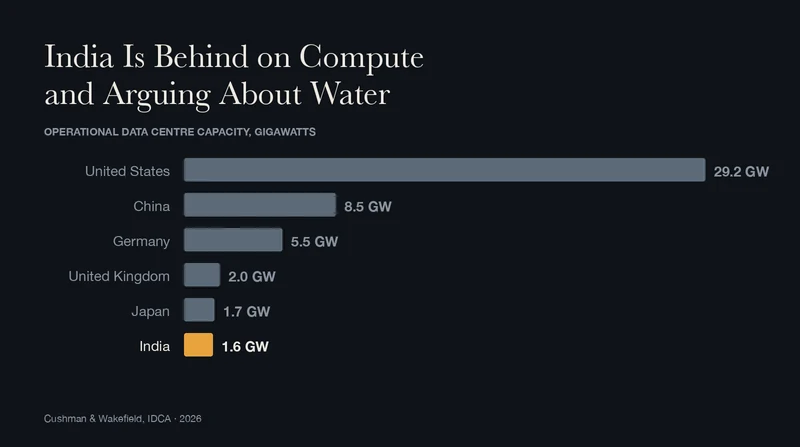 India Is Behind on Compute and Arguing About WaterAug 2026
The data centre panic in India is mostly imported, and the number at the centre of it is wrong.
Think Roko's Basilisk: The Thought Experiment Gilfoyle Mentions in Silicon ValleyMar 2026
Roko's Basilisk, the strange philosophical idea from Silicon Valley that suggests a future AI might judge whether you helped create it.
Think