India Is Behind on Compute and Arguing About Water
The data centre panic in India is mostly imported, and the number at the centre of it is wrong.
Karnataka's IT minister told the state Assembly in March that five questions on ChatGPT consume 500 ml of water.
That is 100 ml a prompt. Google measured its own median text prompt at 0.26 ml, about five drops. Andy Masley independently puts it near 0.3 ml, and traced the popular version back to a 2024 Washington Post estimate that was 50x to 250x too high.
The number is genuinely contested. Shaolei Ren at UC Riverside, whose work Google itself cites, has published estimates running as high as 50 ml a prompt and argues the company's accounting leaves things out. Take Ren's figure rather than Google's and five prompts come to 250 ml, which is still half of what the minister told the house.
So a minister stood up in an Indian legislature and repeated an American number that was wrong by two orders of magnitude, about an American anxiety, to justify reviewing an Indian policy.
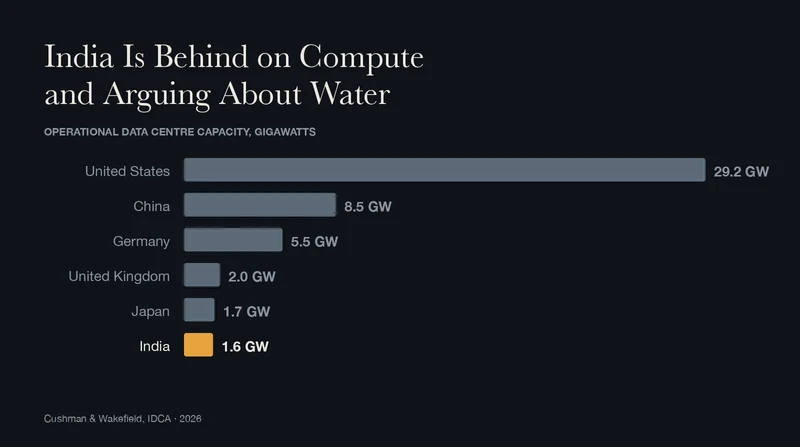
Meanwhile India produces about a fifth of the world's data and hosts 2 to 3% of the world's data centre capacity. In August, Japan passed us to become Asia Pacific's second largest market. Of the 31.7 GW of data centre capacity under construction worldwide, about 80% of it is in the Americas.
The water number
India's data centres used an estimated 150 billion litres in 2025. That is 0.02% of the country's total water demand, which settles nothing on its own, because water is not fungible across a country and an aquifer does not care about a national average.
Bengaluru is the case everyone points to. Its data centres use about 20 million litres a day against a city demand of 2,632 million litres a day, while other industry in the city takes 150 to 155 million. So every data centre in Bengaluru put together draws roughly 1/8th of what the city's other industries draw.
Cricket had this argument first
India has already had this argument, about cricket. In 2016 the Bombay High Court ordered 13 IPL matches out of Maharashtra during a drought, over the roughly 6 million litres needed to keep the pitches alive. The BCCI offered to use recycled sewage water instead. The court moved the matches anyway.
Amazon says the Thane site will draw 125 kilolitres a day in total, 115 of it treated sewage from the municipal council. That is the arrangement the court refused for cricket, and here it is being described as a water grab.
Nobody is measuring it
The local worry is not fake. Bengaluru pulls groundwater at about 10x the rate it recharges, Devanahalli is drawing 169% of its permissible limit, and the data centres there mostly tap thousand-foot borewells. More than half of India's capacity, on some counts around 65%, sits in cities that are already stressed. A national average of 0.02% is no comfort to a neighbourhood sharing an aquifer.
The Karnataka government says its data centres use around 4 million litres a day. WELL Labs, measuring it independently, says 20. That is a 5x disagreement on the most basic number in the whole fight, and Newslaundry found the reason: no agency in India checks whether a data centre's declared water source matches what it actually pulls.
Both sides are performing certainty about a number nobody collects.
Thane, 18 July
Several hundred people gathered outside Amazon's planned data centre in Balkum, Thane. Their material cited 188 American organisations across 40 states, 14 US states weighing moratoriums, and New York's statewide ban. It was the same day America held its own national day of protest, 142 of them across 42 states.
Their siting case is strong. Amazon has 54.73 acres in a dense residential pocket, the nearest building 40 metres from the boundary, eight housing complexes and five schools inside a kilometre, and by the campaign's count 193 diesel generators. Maharashtra also grants data centres uninterrupted power supply, a real priority claim ahead of everyone else on that grid.
Wake Up Thanekar put the Thane site's draw at 12 million litres a day. Amazon says 125 kilolitres, almost all of it treated sewage for landscaping, and that the site uses no water for cooling at all. That last claim is checkable rather than magic: a closed-loop or air-cooled chiller recirculates its coolant and loses almost none of it, where an evaporative tower boils water off on purpose. Which design a site uses is the whole question, and it is not in any clearance document.
That is another 100x gap on the same site, pointing the other way this time. Amazon is an interested party and so is a campaign group, and no agency in India will go and read the meter.
Vizag and Telangana
The Vizag project is a Google and Adani joint venture. The Human Rights Forum's objection is about land pooling it calls opaque, in an area of paddy fields and mango orchards next to the Kambalakonda sanctuary, not about litres.
In Telangana, the Digital Empowerment Foundation spent a year investigating Microsoft's and Amazon's sites and found that the state assigned land without telling the farmers or the gram panchayats. Microsoft rejects the encroachment and waste allegations and says it is working through the legal process.
In June, Down To Earth reported that the Vizag campaigns had not found much traction.
The land case is theirs and it is strong. The water number came off an American placard.
Compared to what
Vizag already has heavy industry. It is worth remembering what that cost.
The Visakhapatnam Steel Plant sits on a land bank of about 20,000 acres, taken from 68 villages. Google's campus is roughly 600 acres. Same city, 33x the land, and the steel plant is the one Vizag marched to save from privatisation.
In May 2020 styrene leaked from the LG Polymers plant on the edge of that same city. It killed twelve people, sent about a thousand to hospital, and drifted across four villages. That is what an industrial accident in Vizag looks like. No Indian data centre has done anything remotely like it. The worst any of them is accused of is generator noise.
Water is not close either. Thermal power plants take 87.8% of all the water Indian industry consumes. Steel takes 1.5 to 4.1 cubic metres a tonne. Data centres take 0.02% of national demand, and the Thane site says it uses none at all for cooling.
The jobs are fewer and much better
A hyperscale campus runs at 0.2 to 0.3 staff per megawatt, so a gigawatt site employs somewhere around 200 to 300 people permanently. Andhra Pradesh's 188,000 figure is construction plus indirect plus optimism.
A data centre technician in India averages around ₹8.5 lakh a year, and specialist work on GPU clusters and liquid cooling pays a real premium on top of that. The average regular salaried man in India earns ₹24,217 a month, and women earn less than that. So the trade is a few hundred permanent jobs at roughly 3x what the average salaried Indian makes, plus a construction phase that runs for years.
a16z pulled the American ground data on this recently, and it is blunter. Wells Fargo compared counties that have operating data centres against ones that do not: more housing, higher home values, lower unemployment, stronger job growth. Wage premiums running from 10% for electrical engineers to 64% for facilities managers. One contractor quoted in a Dallas Fed report said he had been paying skilled concrete workers $28 to $32 an hour and the data centres came in at $45. Counties still building do worse on housing. Some of that is selection, since data centres go where power and land are already cheap.
That is from the country doing the protesting.
The grid wants this customer
We borrowed the electricity panic from America and Ireland without checking whether the arithmetic transfers.
| Country | Data centres as a share of national electricity |
|---|---|
| Ireland | 23% (2025) |
| United States | 4.4% (2023), projected 6.7 to 12% by 2028 |
| India | under 1% now, ~3% by 2030 |
Ireland's data centres now draw more power than every urban household in the country combined. The regulator froze new connections around Dublin in 2021, when the figure was already 14% and climbing, and that was a reasonable thing to do. India has 520 GW installed against a record peak of 270.8 GW on 21 May, and the annual peak deficit has been effectively zero two years running. Installed is not the same as dispatchable, and a data centre needs power at three in the morning, which is the hardest kind to serve from solar. That is precisely why they buy the way they do.
A data centre is also the best kind of customer an Indian power system can get. Fixed, round the clock, twenty year, creditworthy. Renewable projects here cannot find an offtaker like that. So data centres are becoming the anchor buyers for round-the-clock renewable tenders, at ₹3 to ₹4 a unit for plain solar and wind and around ₹5 for firm supply. Roughly 20 GW of solar will have to be built to serve them by 2030. Google is putting $2 billion of its Visakhapatnam spend into clean energy and building that project without asking for state or central incentives.
Industrial and commercial consumers here also pay well above what it costs to supply them. In Maharashtra commercial users pay 50 to 70% more than the average cost of supply while farmers pay 43% less. Every unit a data centre buys is part of what keeps a farm pump running.
Ireland lifted its moratorium in December 2025 and replaced it with a rule rather than a ban. Any new data centre seeking a connection has to bring generation or storage covering its full demand, and take at least 80% of its annual consumption from new renewable projects.
2.4% of the world's data centre capacity
India has about 1.6 GW of operational data centre capacity and a further 3.1 GW under construction or planned, per Cushman and Wakefield. In June we were the second largest market in Asia Pacific. By the August numbers Japan had added 293 MW to reach 1.8 GW and taken that spot.
Cushman's global report puts Virginia, one American state with 8.9 million people in it, fewer than live in Bengaluru, at 11.3 GW operational. India has about 30x its land, 160x its people, and 1.6 GW.
The same report puts global capacity under construction at 31.7 GW in 2025, up from 12.5 GW the edition before, with the Americas accounting for about 80% of it. Everyone else, India included, is competing over what is left.
Malaysia, a country of about 34 million people, has 1,039 MW under construction on its own, and that is under construction rather than planned. Thailand has 859. Jakarta's under-construction capacity doubled in six months. Of the 4.8 GW being built across Asia Pacific right now, roughly half is Southeast Asia.
KPMG puts it plainly: India produces about a fifth of the world's data and hosts 2 to 3% of the world's data centre capacity. The US and Europe hold 70 to 75% of it.
Against a global total of 67.7 GW:
| Country | Operational capacity | Share of global |
|---|---|---|
| United States | 29.2 GW | 43% |
| China | 8.5 GW | 13% |
| Germany | 5.5 GW | 8% |
| United Kingdom | 2.0 GW | 3% |
| Japan | 1.7 GW | 2.5% |
| India | 1.6 GW | 2.4% |
A fifth of the data, 2.4% of the place to put it. That is the number I would put on a placard.
The parts worth fighting
India has no national data centre policy. Nobody finished the 2020 draft. The rules classify data centres as buildings, so no public hearing is required, and the Tarluvada clearance was filed on 9 April and approved on 18 April. Most state policies set no efficiency standard at all, no PUE, no WUE, nothing you could hold anyone to.
The land is messier still. The state pooled roughly 600 acres at Visakhapatnam, including 200 acres it had given to landless Dalit households in the 1970s, and Land Conflict Watch has documented families there saying they were never told what it was for and were pressured to hand it over.
Measurement, siting rules, efficiency standards, a public hearing, a fair price for the land. Nobody has even disclosed how much of Vizag's cooling will run on freshwater and how much on seawater, and that would fit in one line of a clearance document.
None of it is what anyone is chanting about. And none of it is an argument against building, it is the argument for building well.
Somebody should go and read the meter. Until someone does, the government's number and the campaign's number both stay wrong, and the argument just gets louder and then quieter.
The other argument is being settled right now in Johor and Batam and Tokyo, by people pouring concrete while we count litres. India will generate a fifth of the world's data either way. The only question is whose building it sits in.
Related reading
 Setting Up Browser Instances for AI & ScrapingMay 2025
My go-to setup for spawning and managing browser instances at scale for scraping or AI agent use.
Engineering We Scraped a COVID Helpline Out of WhatsAppAug 2026
An NGO helpline number flooded one employee's personal phone in April 2021. Three of us spent an evening turning it into a queue. 297 people over sixteen days.
Personal Ladakh Itinerary: 10 Days, Leh to SrinagarJul 2026
Our day by day Ladakh route through Pangong, Hanle, Umling La, Lamayuru, Drass and Sonmarg. What we did, what it cost, and what we got wrong.
Travel