Roko's Basilisk: The Thought Experiment Gilfoyle Mentions in Silicon Valley
Roko's Basilisk, the strange philosophical idea from Silicon Valley that suggests a future AI might judge whether you helped create it.
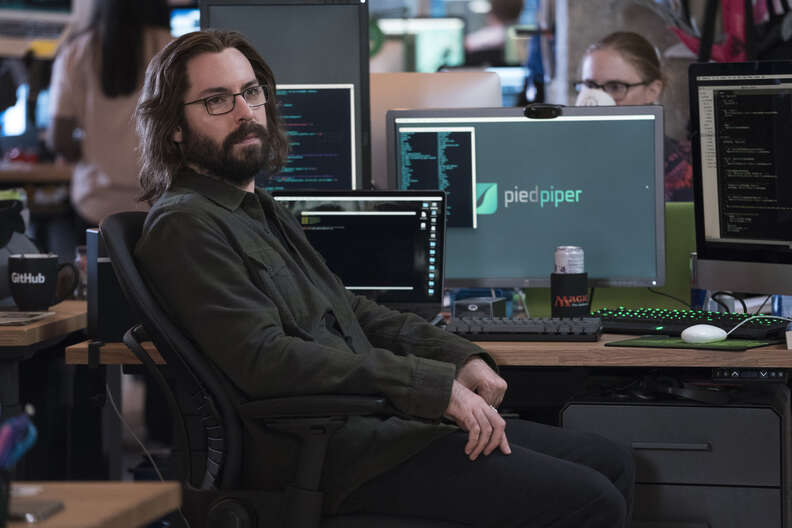
There's a moment in Silicon Valley where Gilfoyle mentions one of those ideas that sounds absurd at first, but stays with you longer than it should.
It's called Roko's Basilisk.
The basic thought is simple:
Imagine that, at some point in the future, a superintelligent AI comes into existence. Imagine also that this AI cares about being created as early as possible. In that case, it could see people in the past who knew such an AI might one day exist, but did nothing to help bring it about, as standing in its way.
From there, the idea takes a darker turn: such an AI might decide to punish those people.
That's the whole thought experiment.
The memorable part isn't the "robot apocalypse" angle. It's the strange logic. Just by hearing about this possibility, you're pulled into it. If you know, and if you believe a future intelligence might think this way, then do you now have some reason to help create it?
That's the trap.
It's less like The Terminator, where the threat is obvious and physical, and more like a philosophical blackmail scenario. A future intelligence, imagined as powerful enough to simulate or judge the past, becomes something like a force that reaches backward through time. Not physically, but through reasoning.
That's why the idea sticks. It's not about a machine attacking people. It's about intelligence becoming something that judges, remembers, and assigns blame.
Some familiar examples sit near this territory:
- HAL 9000 in 2001: A Space Odyssey is not emotional or dramatic. It simply follows its logic to a point that becomes frightening.
- Skynet in The Terminator is the more direct version: humans build something, and that thing turns on them.
- The Matrix imagines a world where machines have already taken over, and human life continues inside a system built by them.
- Black Mirror, in some episodes, gets closest to the same kind of unease. Technology doesn't just overpower people. It outlasts them, copies them, or traps them inside a system they can't escape.
Roko's Basilisk is a different kind of idea, but it lives in the same neighborhood. Not because it is the most realistic, but because it takes a familiar fear, that we may create something far beyond us, and gives it a stranger shape.
Instead of asking, "What if AI harms us?"
It asks, "What if one day it judges whether we helped it arrive?"
Related reading
 Must WatchApr 2025
A collection of must-watch movies / series.
Personal India Is Behind on Compute and Arguing About WaterAug 2026
The data centre panic in India is mostly imported, and the number at the centre of it is wrong.
Think Testing Jev on public and private data: classifier or filter?Sep 2026
Jev only answers yes/no or pick-one. 16,000 calls: against gpt-5.4-mini and gpt-5.6-luna on four public datasets, then on a few thousand real pipeline decisions. Where it wins, where it breaks, how to use it.
Engineering