How to Register a Pvt Ltd Company in India, the Right Way
A founder's plain-English guide to registering a Private Limited company in India, plus the auditor and Form 20-A deadlines that catch first-timers.
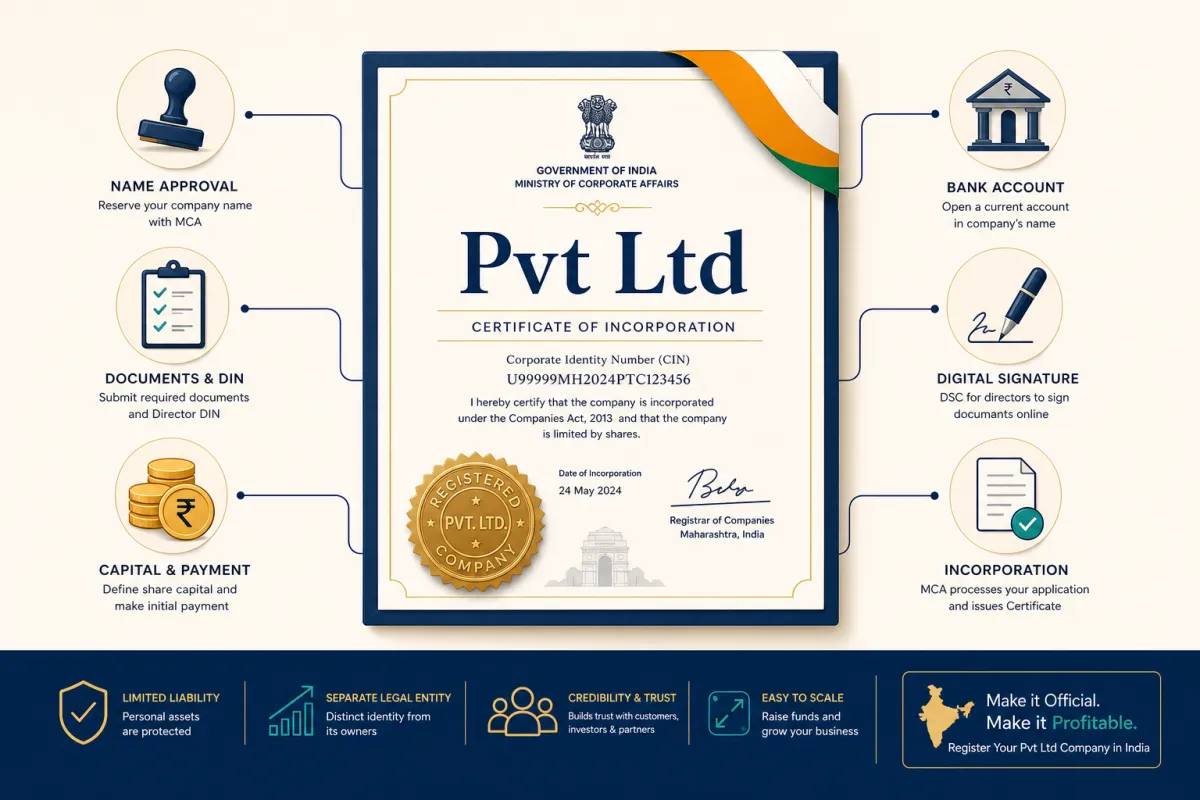
The hard part of starting a Private Limited company in India isn't the idea or the product. It's the part where your company is technically born but you still can't legally do anything with it, and nobody tells you that until you've already missed a deadline. Miss one and you can owe ₹1,000 a day, or have your brand-new company struck off the register. Incorporation is the easy part. The deadlines that follow are where people get caught. Here's the whole registration path, in order.
I'm not a CA, and this isn't legal advice. If you have real doubts about your situation, talk to one.
First, the acronyms you'll live with
Get these straight early. Mixing them up causes half the confusion:
- CIN: Company Identification Number, your company's unique ID.
- DIN: Director Identification Number. It's yours personally, lifelong, and the same across every company you ever direct.
- DSC: Digital Signature Certificate. Also personal to you (linked to your PAN). It's how you sign documents online, and it carries across companies.
- PAN / TAN: your company's tax IDs, issued together with the CIN.
- MOA / AOA: Memorandum and Articles of Association. Your CA drafts these; keep them safe forever.
A founder becomes a Director. Every director needs a DIN and an individual DSC. One nuance worth knowing: a DSC is needed before incorporation, because the subscribers have to digitally sign the incorporation form. And these days only the Class 3 DSC exists. Class 2 was discontinued back in January 2021, so wherever a guide says "Class 2," ignore it.
Step 1: Pick a name (this is where the time goes)
Choose a name and check its availability before you apply for anything else. This is where most of the calendar disappears. The official timeline for CIN + PAN + TAN is roughly 2 weeks, but a month is common, and it's almost always the name going back and forth that causes it.
The entire process is online through the MCA portal, and the whole incorporation runs through one web form called SPICe+ (the successor to the old INC-32). It has two parts:
- Part A reserves your company name. (The old standalone "RUN" service is now only for renaming an existing company, so don't go looking for it to register a new one.)
- Part B does everything else: DIN allotment, company PAN and TAN, and optional add-ons like GST, EPFO/ESIC, and a bank account, all bundled into one filing.
So: think hard, check the name, then file. CIN, PAN, and TAN all come out together at the end.
Step 2: Gather your documents
For the registered office:
- Rental / lease agreement
- A No-Objection Certificate (NOC) from the property owner. Don't skip this; an unsigned or missing NOC is one of the most common rejection reasons
- A recent utility bill (electricity / water / gas), in the owner's name and not older than two months
Make sure the address and owner name match consistently across all three.
For each director:
- PAN card
- Aadhaar card
- Passport-size photo
- Recent bank statement, with the name spelled exactly the same everywhere
Step 3: Decide equity and paid-up capital
- Agree on shareholdings between all founders before you file, not after.
- Decide your paid-up capital. Simple example: two founders, equal split, ₹10,000 paid-up capital, so each deposits ₹5,000 into the company's account in proportion to their shares.
Step 4: Incorporation
Your CA prepares the MOA and AOA. Once everything checks out, MCA issues your Certificate of Incorporation, carrying your CIN, with the company PAN and TAN printed right on it.
⚠️ You still can't run the business yet. This is the part that trips up almost every first-timer. The next few steps matter as much as the incorporation itself.
Here's the whole clock, in one place:
- Day 30: appoint your first auditor (file ADT-1)
- Day 90: backstop, if the board missed it, shareholders must appoint
- Day 180: file Form 20-A, or risk being struck off
The steps below are grouped by topic, not strictly by date, so keep these three dates as your real deadlines.
Step 5: The 30-day clock: appoint an auditor
Within 30 days of incorporation, the board must appoint the company's first auditor (this is Section 139(6) of the Companies Act, 2013). They'll handle most of your ongoing compliance, so choose carefully. The appointment is filed in form ADT-1, and as of July 2025 that filing is mandatory for the first auditor too (it used to be treated as optional, and outdated advice still says so). If the board misses the 30 days, the shareholders must appoint within 90 days.
Step 6: Get a company seal and your Class 3 DSC
Once you have the CIN:
- Get a company seal for any offline document signed on behalf of the company.
- Make sure your Class 3 DSC is ready for everything signed online.
Step 7: Geo-tagged office photos
Take a geo-tagged photo of the directors both in front of and inside the registered office, with a company-branded board clearly visible. One director can technically do it, but having all directors in the shot is the safer move.
Step 8: GST, DPIIT & Startup India
- GST: It's not automatically mandatory the day you incorporate. It kicks in when you cross the turnover threshold (around ₹40 lakh for goods, ₹20 lakh for services, roughly half that in special-category states like the North-East) or hit a compulsory trigger like selling inter-state, e-commerce, or exports. Still, having GST early smooths a lot of things like vendor onboarding, invoicing, and banking, so many founders register for GST on purpose before they have to.
- DPIIT recognition + Startup India: Worth doing. It's free, usually cleared in a few days, and unlocks real perks (more below).
Step 9: Bank account + Form 20-A (commencement of business)
The clock: 180 days from your CIN to file Form 20-A. Miss it and the company can be struck off.
This is the deadline that turns a "registered company" into one that can actually operate. By now you should already have your Class 3 DSC, your geo-tagged office photos, and (optionally, but handy) your DPIIT recognition in hand from the earlier steps.
With those ready, here's what's left to do, in order:
- Open a company bank account
- Deposit your paid-up capital first (each director's share); this is a prerequisite for the next step
- File Form 20-A (INC-20A)
What Form 20-A actually does: the "Declaration for Commencement of Business" (Section 10A) is what gives you the legal right to operate. Once it's filed and accepted, you can operate and use borrowing powers.
Until that's done, don't use the bank account for anything except depositing your paid-up capital. No revenue, no expenses, nothing else.
🚨 Skipping INC-20A is expensive and dangerous. It's the most common mistake first-time founders make:
₹50,000 on the company, ₹1,000 a day per officer in default (capped at ₹1 lakh), and the Registrar can strike you off entirely, all for missing one form (INC-20A) in your first 180 days.
Once Form 20-A is in, you're genuinely good to go. After that:
- File your ITR on time
- Keep up with the routine annual compliance your auditor will guide you on
And now that you can operate, the next problem is getting people to use what you've built. I keep a running launch and growth checklist for exactly that.
That's the numbered path, start to finish. Two things, though, deserve more room than a single step allows.
A word on "0 tax for 3 years"
You'll hear that Startup India gives you "zero tax for three years." The truth is more nuanced, and worth getting right:
- DPIIT recognition is the gateway, not the tax break. It makes you eligible; it doesn't grant the exemption by itself.
- The actual tax holiday is Section 80-IAC: a 100% exemption on profits for any 3 consecutive years, chosen from your first 10 years. It needs a separate approval from an Inter-Ministerial Board (IMB), which is selective, not a rubber stamp.
- It only helps if you're actually turning a taxable profit in those years.
- To even be eligible, your company must be incorporated on or before 31 March 2030 (extended in Budget 2025) and have turnover under ₹100 crore.
So: apply for it. Just know DPIIT only gets you in the room. The IMB hands out the actual tax holiday, and only if you're turning a profit in those years.
Other DPIIT perks that are straightforward: self-certification on several labour and environment laws, up to 80% rebate on patent filing fees and fast-tracked examination, and access to government seed-fund and collateral-free loan schemes. (The 80% rebate on the patent office's statutory fees and fast-tracked examination both still apply. The older scheme where the government also covered your patent facilitator's professional fees (SIPP) has since lapsed, so confirm what's current when you file.)
The bank account, the honest version
On paper, opening a current account is a formality. In reality, most banks won't do much for you until you park a serious balance, and nobody warns you before you walk in. Here's the honest lay of the land (balance figures vary by branch and city, so treat them as ballpark):
Shortcut: If you have a good relationship with a manager at any bank, just go to them and relax. The rest of this section is for everyone else.
Government banks (SBI, PNB, etc.)
- Will open an account at the lowest minimum balance
- But expect it to be slow: unreliable servers, indifferent service, and long waits for both account opening and basic queries
Private banks
- ICICI: won't bend much. Come with money first, then talk.
- HDFC, Kotak Mahindra: roughly ₹50k minimum balance, but the full private-bank experience
- Others (IDFC, AU, Axis): roughly ₹25k minimum, a notch below the above but perfectly fine
Want a zero / low minimum-balance account?
- A DPIIT certificate helps. Some banks (e.g. IDFC FIRST) waive non-maintenance charges for DPIIT-recognised startups for a few years. It's a bank-by-bank perk, not a government guarantee, so terms differ.
- Apply through the bank's online / startup channel. Walking into a branch for this tends to get a flat "no."
Common questions
How long does Pvt Ltd registration take in India?
Officially about 2 weeks for CIN + PAN + TAN; realistically closer to a month. The delay is almost always name approval, so lock and check the name before you file anything else.
Is GST mandatory for a new Pvt Ltd company?
No. Incorporating a company doesn't register you for GST. It kicks in when you cross the turnover threshold (around ₹40 lakh for goods, ₹20 lakh for services, roughly half that in special-category states) or hit a compulsory trigger like inter-state sales, e-commerce, or exports.
What is the penalty for not filing INC-20A?
₹50,000 on the company, plus ₹1,000 per day on every officer in default (capped at ₹1 lakh). And if the Registrar believes you're not operating, they can strike the company off the register entirely.
When do I appoint the first auditor?
The board must appoint the first auditor within 30 days of incorporation (Section 139(6)), filed in form ADT-1. If the board misses it, the shareholders must appoint within 90 days.
What does it cost to register a Pvt Ltd company?
Treat any number as ballpark, it varies by state. The government SPICe+ filing fees are low (near-zero up to a modest authorised-capital threshold). The real cost is your CA's professional fee, the DSCs for each director, and state stamp duty, which differs from state to state. Budget for the CA and stamp duty more than the MCA fees themselves.
What documents do I need?
For the registered office: a rental/lease agreement, a signed NOC from the owner, and a recent utility bill in the owner's name (not older than two months), with the address and name matching across all three. For each director: PAN, Aadhaar, a passport-size photo, and a recent bank statement, with names spelled identically everywhere.
What is SPICe+?
It's the single MCA web form the whole incorporation runs through. Part A reserves your company name. Part B does everything else: DIN, company PAN and TAN, and optional add-ons like GST and EPFO/ESIC, all bundled into one filing.
Useful links
Stick to the official portals over third-party sites:
- MCA portal for incorporation and post-incorporation filings like ADT-1 and INC-20A
- SPICe+ dashboard, the incorporation web form itself
- Startup India for DPIIT recognition and startup benefits (the recognition application is filed through the National Single Window System)
- GST portal for GST registration and returns
- Income Tax e-filing for PAN, ITR, and the 80-IAC tax exemption
Getting incorporated feels like the finish line, but the clock is still running. Apply, file, and watch it: 30 days for the auditor, 180 for Form 20-A. And if something here applies to your specific situation, run it past a CA before you act. They'll catch the edge cases this guide can't.
If this saved you a deadline, I write about building and shipping things, most of it learned by tripping over exactly these kinds of details.
Related reading
 Profilebud: My First Taste of Startup SuccessJun 2025
Scraper grew to $7K MRR before Instagram shut us down
Work Engineer vs EntrepreneurMay 2025
A short story and reflection on builders vs visionaries — and figuring out where you fall.
Work The Power of 1%: Habits for an Entrepreneur-EngineerJun 2025
Small daily, weekly, and monthly actions that compound into massive growth—tailored for founders and engineers.
Work