Understanding Brainwaves and Their Applications
Delta to gamma, what each brainwave band is associated with, and where EEG gets used in practice.
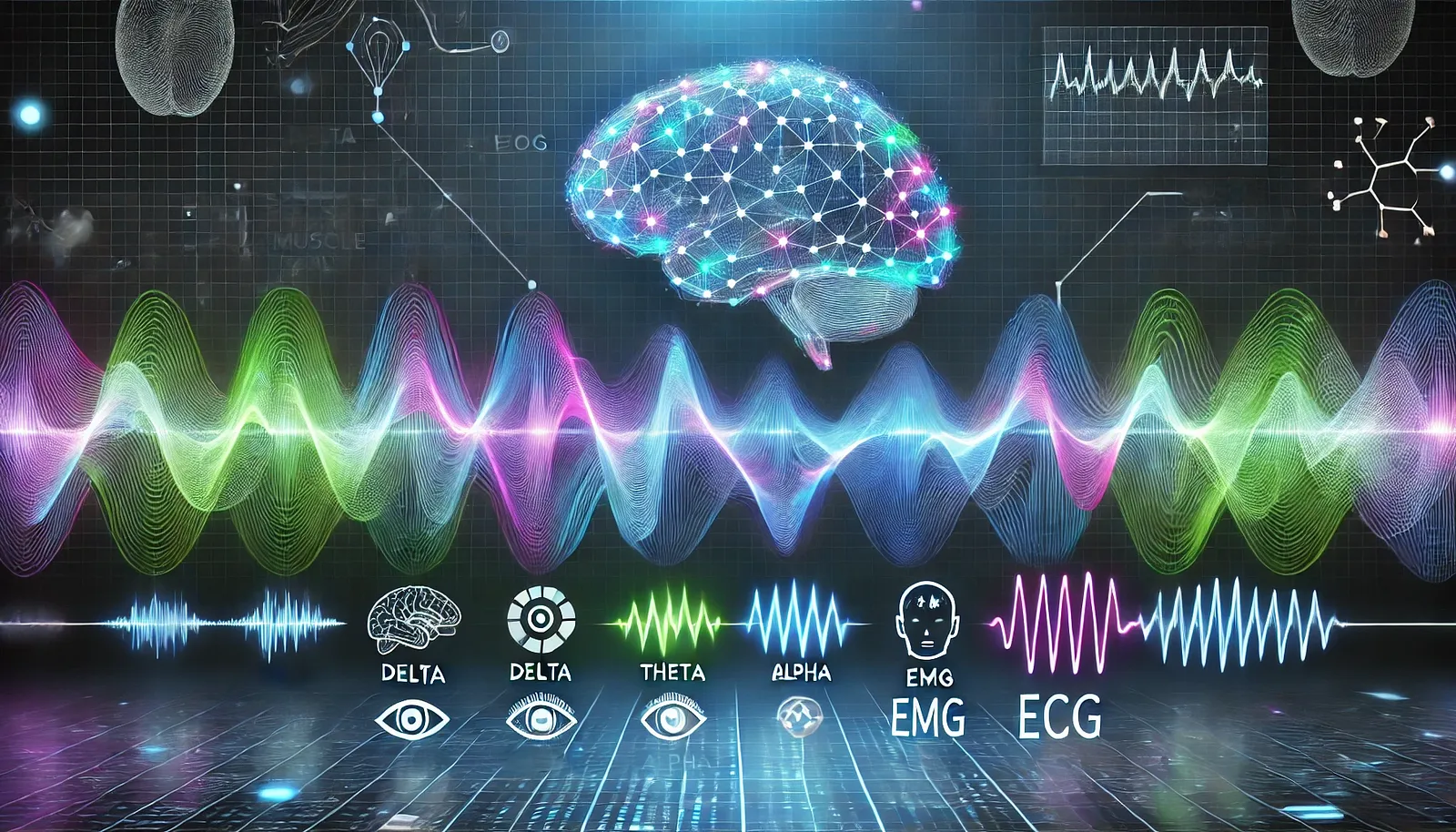
Introduction
Brainwaves are the electrical signals generated by neurons in the brain. These signals are measured in different frequency bands and are crucial for understanding various mental states, such as relaxation, concentration, and sleep. Technologies like Electroencephalography (EEG) capture these signals, enabling applications in health, human-computer interaction (HCI), brain-computer interfaces (BCI), and more. While consumer-grade kits offer basic access to these signals, advanced technologies like Neuralink aim to push the boundaries of what is possible by tapping directly into neurons with high precision.
This report explores the fundamentals of brainwaves, their associated technologies (EEG, EOG, ECG, etc.), their applications, and the difference between consumer kits and advanced platforms like Neuralink.
Brainwaves: The Basics
Brainwaves are categorized based on their frequency and amplitude. Each category corresponds to a different mental or physiological state. Here are the primary types of brainwaves:
1. Delta Waves (0.5-4 Hz)
-
Frequency: Very slow.
-
Amplitude: High.
-
Origin: Deep within the brain, often associated with sleep and unconscious states.
-
Associated States:
-
Deep sleep and restorative processes.
-
Healing and regeneration.
-
Applications:
-
Sleep monitoring and improvement.
-
Detection of sleep disorders like insomnia.
2. Theta Waves (4-8 Hz)
-
Frequency: Low.
-
Amplitude: Moderate.
-
Origin: Common in the hippocampus, related to memory and relaxation.
-
Associated States:
-
Light sleep or drowsiness.
-
Meditation and creativity.
-
Applications:
-
Meditation apps and stress relief tools.
-
Enhancing creative processes.
3. Alpha Waves (8-12 Hz)
-
Frequency: Moderate.
-
Amplitude: Medium.
-
Origin: Generated in the occipital lobe during relaxation.
-
Associated States:
-
Calm and relaxed yet awake.
-
Quiet reflection or mild focus.
-
Applications:
-
Relaxation and focus enhancement tools.
-
Neurofeedback for stress reduction.
4. Beta Waves (12-30 Hz)
-
Frequency: Fast.
-
Amplitude: Low.
-
Origin: Associated with active brain regions during tasks.
-
Associated States:
-
Concentration, alertness, and problem-solving.
-
Applications:
-
Monitoring attention and cognitive load.
-
High-focus tasks in gaming and work environments.
5. Gamma Waves (30-100 Hz)
-
Frequency: Very fast.
-
Amplitude: Low.
-
Origin: Associated with higher-order cognitive functions and sensory processing.
-
Associated States:
-
Problem-solving and memory recall.
-
Multi-sensory integration.
-
Applications:
-
Advanced cognitive monitoring.
-
Fine motor control in robotics.
Signal Modalities: Beyond EEG
While EEG is the most common way to measure brain activity, other modalities capture complementary signals. Here are the key technologies:
1. Electroencephalography (EEG)
-
What it Measures: Electrical activity from the brain.
-
Source: Signals generated by neuron firing, captured through electrodes on the scalp.
-
Applications:
-
BCIs for controlling devices using mental states.
-
Neurofeedback for relaxation or focus.
-
Diagnosing neurological conditions like epilepsy.
2. Electrooculography (EOG)
-
What it Measures: Electrical signals from eye movements.
-
Source: Muscles controlling the eyes.
-
Applications:
-
Eye-tracking for accessibility tools (e.g., controlling cursors with eye movements).
-
Gaming or HCI applications.
3. Electromyography (EMG)
-
What it Measures: Electrical activity from muscles.
-
Source: Muscle contractions.
-
Applications:
-
Gesture-based controls (e.g., smiling to trigger actions).
-
Prosthetic limb control for amputees.
4. Electrocardiography (ECG)
-
What it Measures: Electrical activity of the heart.
-
Source: Heart muscle contractions.
-
Applications:
-
Stress and health monitoring.
-
Combining physiological and neurological data for holistic insights.
Applications of Brainwave Technologies
1. Brain-Computer Interfaces (BCI)
BCIs enable users to interact with computers and devices directly through brain activity.
-
Example Applications:
-
Controlling robotic arms or wheelchairs for people with disabilities.
-
Hands-free typing or cursor control.
-
Gaming applications where mental states control in-game actions.
2. Neurofeedback and Mental Health
-
Train users to achieve desired mental states (e.g., focus, relaxation).
-
Reduce stress, anxiety, and improve sleep quality.
3. Accessibility Tools
-
Eye-controlled interfaces for individuals with mobility impairments.
-
Prosthetics controlled through EMG or EEG signals.
4. Gaming and Entertainment
-
Use brain activity to control characters or adjust gameplay intensity.
-
Enhance immersion by reacting to the player’s mental state.
5. Health Monitoring
-
Detect and manage conditions like epilepsy, ADHD, or sleep disorders.
-
Monitor stress levels and provide real-time interventions.
Simple Kits vs Neuralink
Simple EEG Kits
-
Examples: DIY Neuroscience Kits, OpenBCI.
-
Cost: Affordable (a few hundred dollars).
-
Setup: Non-invasive, with electrodes placed on the scalp.
-
Capabilities:
-
Detect basic brainwave patterns (Alpha, Beta, etc.).
-
Control simple devices (e.g., turning lights on/off, moving cursors).
-
Useful for beginners and hobbyists in neuroscience and BCIs.
-
Limitations:
-
Low signal resolution due to interference from the skull and noise.
-
Limited to surface-level brain activity.
-
Not suitable for precise or high-bandwidth tasks.
Neuralink
-
What It Is: An advanced BCI company developing implantable brain interfaces.
-
Cost: Currently experimental and not commercially available.
-
Setup: Invasive, involving implanting electrodes directly into the brain.
-
Capabilities:
-
High-resolution access to neural activity.
-
Real-time decoding of complex signals (e.g., controlling robotic arms).
-
Applications in medical fields (e.g., restoring movement in paralyzed individuals).
-
Challenges:
-
Requires surgery and long-term safety testing.
-
Ethical and regulatory hurdles.
Comparison Table
FeatureSimple KitsNeuralinkInvasivenessNon-invasiveInvasiveSignal QualityLow resolutionHigh resolutionApplicationsBasic HCI, gamingMedical-grade BCIsCostAffordableExperimentalComplexityEasy to useRequires surgery
Challenges in Advancing BCI Technologies
1. Signal Noise
- Non-invasive systems are affected by noise from the skull, muscles, and environment.
2. Real-Time Decoding
- Decoding brain activity into precise commands requires advanced machine learning and low-latency systems.
3. Long-Term Viability
- Implantable systems like Neuralink must address issues like biocompatibility, infection risk, and electrode degradation.
4. Ethical and Privacy Concerns
-
How should brain data be used and stored?
-
Could such technologies be misused for surveillance or manipulation?
Conclusion
Brainwave technologies hold immense potential for applications ranging from health monitoring to advanced human-computer interaction. While simple kits provide a gateway for hobbyists and researchers, companies like Neuralink aim to revolutionize the field with precise, high-bandwidth interfaces that directly interact with neurons. The path forward involves overcoming technical, ethical, and regulatory challenges, but the possibilities for improving lives and augmenting human capabilities are vast.
Whether you’re exploring brainwave technologies for personal projects or advanced applications, understanding the fundamentals of these signals and their potential applications is key to unlocking their power.
Related reading
 You Are Less in Control Than You ThinkJan 2026
What neuroscience reveals about choice, behavior, and the illusion of free will.
Think The 80/20 RuleMar 2024
The Pareto principle, and how to apply it to work and life instead of just quoting it.
Personal Good ReadsJul 2026
The books I keep going back to, and what each one changed for me. Mostly psychology, product and design.
Personal