You Are Less in Control Than You Think
What neuroscience reveals about choice, behavior, and the illusion of free will.
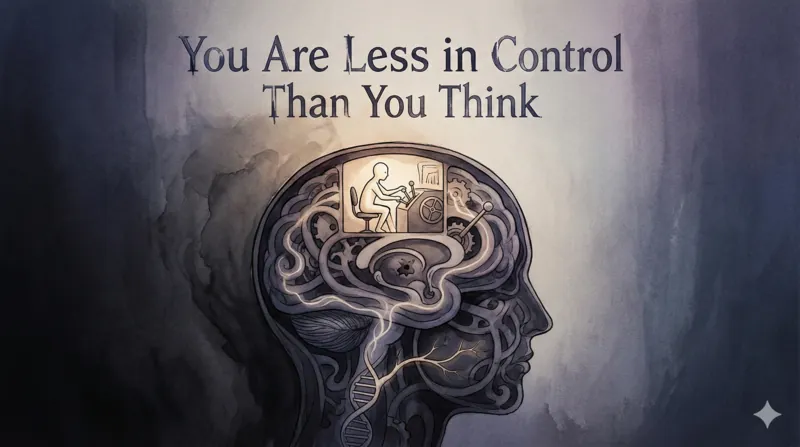
Are we really in control of ourselves?
I recently finished reading Incognito: The Secret Lives of the Brain by David Eagleman, and it quietly dismantled one of my most comfortable assumptions: that I am the author of my thoughts, decisions, and actions.
The book’s core idea is simple, unsettling, and hard to ignore once seen.
The short version
You are not in control the way you think you are.
Most decisions, emotions, and behaviors are driven by brain processes that operate outside conscious awareness. The feeling of choice often arrives after the decision has already been made.
The brain moves first
We experience life as if a single “self” is in charge, carefully weighing options and choosing paths. In reality, the brain is a collection of specialized systems constantly competing and cooperating.
By the time you think, “I decided,” your brain has already acted. Consciousness does not initiate most actions. It explains them.
It is less like a driver and more like a narrator, stitching together a story that makes the outcome feel intentional.
When biology changes, behavior can change overnight
Some of the strongest evidence comes from extreme but real medical cases.
There are documented instances where a brain tumor caused sudden pedophilic sexual urges in an adult with no prior history. The person recognized the urges as wrong, felt distressed by them, and could not explain why they appeared. When the tumor was removed, the urges disappeared.
Nothing about the person’s morals changed. Nothing about their upbringing changed. Only the brain did.
Genes bias behavior, they do not dictate it
The same logic applies in subtler ways.
Some people carry the RS3-334/335 gene variant, sometimes referred to as the infidelity gene. It is linked to weaker pair bonding due to reduced vasopressin activity. Statistically, people with this variant are more likely to cheat.
This does not mean they are destined to be unfaithful. It means attachment may feel less stable and temptation harder to regulate. The struggle itself is unevenly distributed.
Environment decides whether a risk becomes real
Violence shows how biology and environment interact.
Certain MAOA gene variants are associated with increased aggression, but only when combined with childhood abuse or severe neglect. People with the same gene and a stable upbringing often show no violent behavior at all.
The gene alone does nothing. The environment alone does not guarantee violence. It is the interaction that matters.
Biology creates vulnerability. Environment determines expression.
Why this makes morality uncomfortable
We tend to judge people as if everyone starts from the same internal setup. They do not.
Different brains experience impulse, restraint, attachment, fear, and desire very differently. Some people are fighting louder urges with weaker brakes, and most of that fight happens outside awareness.
This does not eliminate responsibility, but it complicates it. Control is not evenly distributed.
Consciousness is not the driver
It is the narrator.
The brain generates behavior. Conscious thought explains it in a way that preserves the feeling of agency. Responsibility still matters, but the idea of full, independent control is thinner, messier, and far more biological than we like to admit.
Once you see this, it becomes harder to look at yourself or others in the same way again.
Related reading
 Understanding Brainwaves and Their ApplicationsJan 2025
Delta to gamma, what each brainwave band is associated with, and where EEG gets used in practice.
Think Good ReadsJul 2026
The books I keep going back to, and what each one changed for me. Mostly psychology, product and design.
Personal Universe Theories, From the Big Bang to the Dark ForestAug 2026
Thirty-one ideas about how the universe began, what it is made of, whether it is the only one, why space looks empty, and how it ends.
Think