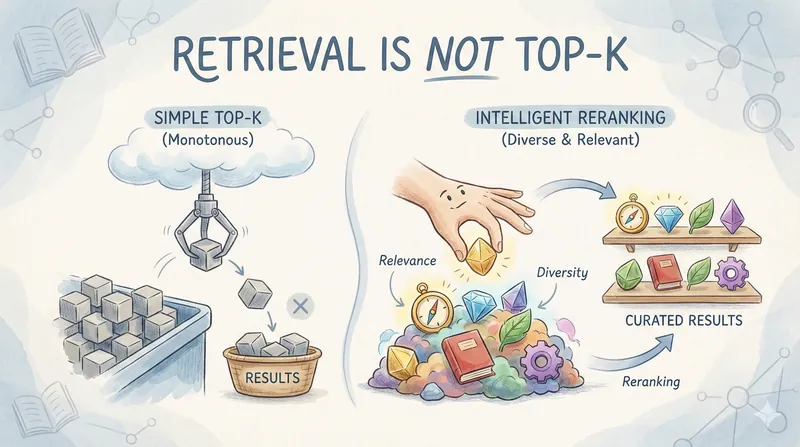
Part 3: Retrieval Is Not Top-K
Relevance, diversity, reranking, and why most systems return the wrong things for the right reasons
This is Part 3 of a 4-part series on embeddings. Part 1: Embeddings: Turning Meaning Into Geometry | Part 2: How Embeddings Actually Work in Practice | Part 4: From Retrieved Context to a Grounded Answer
By Part 2, we fixed the obvious problems:
- chunks are meaningful
- dimensions are reasonable
- embeddings are not doing unnecessary damage
And yet, systems still fail.
Results look relevant, but answers are incomplete. Good documents exist, but the model ignores them. Top results repeat themselves.
This is not an embedding problem.
This is a retrieval dynamics problem.
The core mistake: treating retrieval as "top-k"
Most systems do this:
- Embed the query
- Retrieve the top-k nearest vectors
- Pass them to the LLM
This looks reasonable.
It is also one of the most common sources of failure. Why?
Because similarity ranking is not the same as usefulness ranking.
Similarity vs usefulness
Embeddings optimize for semantic similarity.
Users care about task completion.
These are not the same thing.
Example
User asks:
How do I file a claim?
Top retrieved chunks:
- Definition of insurance claims
- History of claim processing
- Regulatory explanation of claims
- One paragraph with actual filing steps
From an embedding perspective, this is a success. From a user perspective, it is a failure.
All retrieved chunks are similar to the query. Only one is useful.
Top-k similarity ranking cannot distinguish this on its own.
Why top results often repeat themselves
A very common symptom:
Your top 5 results all say almost the same thing.
This happens because:
- documents share boilerplate language
- chunks overlap
- policies repeat definitions
Embedding distance does not penalize redundancy.
So you get:
- five very similar chunks
- low information diversity
- wasted context window
The LLM then struggles to synthesize an answer because there is no new signal.
Relevance is not binary
Another hidden assumption in top-k retrieval is this:
Either something is relevant or it is not.
In reality, relevance exists on multiple axes:
- topical relevance
- procedural relevance
- temporal relevance
- authority or version relevance
Embedding similarity mostly captures the first.
If you do not explicitly model the others, retrieval feels random in edge cases.
The idea that fixes many systems: diversity matters
A good retrieval set is not just similar.
It is diverse along the right dimensions.
Instead of asking:
What are the 5 most similar chunks?
You should ask:
What are the most useful 5 different chunks?
This is where diversity-aware retrieval comes in.
Maximal Marginal Relevance (MMR)
MMR is a simple but powerful idea.
It balances:
- similarity to the query
- dissimilarity to already selected results
In practice, it works like this:
- Pick the most similar chunk
- For each next pick, penalize chunks that are too similar to what you already selected
The result:
- fewer duplicates
- more coverage
- better signal density
MMR often improves answer quality without changing embeddings or chunking.
Why reranking exists
Embedding similarity is cheap and approximate.
Sometimes you need a second pass.
Rerankers do exactly that.
They:
- take a small candidate set, often top 20 or 50
- score each candidate more precisely
- reorder them before final selection
Rerankers are slower than embeddings but far more discriminative.
This makes them ideal for:
- resolving subtle distinctions
- preferring procedural answers over definitions
- choosing the best explanation among similar chunks
A common and effective pattern:
- embeddings for recall
- reranking for precision
Retrieval depth matters more than you think
Many systems retrieve only top 5 or top 10 chunks.
This often limits recall unnecessarily.
A better pattern is:
- retrieve a wider candidate set, say 20–50
- then apply diversity or reranking
- finally select a smaller set for generation
This gives your system room to correct early ranking mistakes.
Metadata is part of retrieval, not a hack
A common mistake is treating metadata filters as optional.
Metadata is how you encode non-semantic relevance.
Examples:
- document version
- product line
- geography
- language
- effective date
Embedding similarity cannot infer these reliably.
If your retrieval ignores metadata, you are asking embeddings to do a job they were not designed for.
Good systems combine:
- semantic similarity
- structured filtering
- soft boosting or penalties
Retrieval quality ≠ answer quality
This distinction is crucial.
You can have:
- high Recall@k (retrieved most of the "relevant" chunks)
- good similarity scores
- clean logs
And still produce bad answers.
Why?
Because retrieval quality must be evaluated in context of the task.
The right metric is not:
- did we retrieve something relevant?
It is:
- did we retrieve what the user needed to succeed?
This is why many teams misdiagnose problems as "LLM hallucinations" when the real issue is retrieval selection.
Embedding benchmarks
The main benchmarks for comparing embedding models:
- MTEB — Most comprehensive, covers 8 task types (classification, clustering, retrieval, similarity, etc.). Most models report MTEB scores.
- BEIR — Focused on information retrieval with 18 datasets. More relevant if building search systems.
- STS — Semantic Textual Similarity benchmarks (STS-B, SICK). Tests core embedding capability.
Note: Benchmark scores help choose models, but always validate on your own data and queries.
A practical retrieval pipeline that works
A strong baseline looks like this:
- Rewrite or normalize the query if needed
- Retrieve a wide candidate set using embeddings
- Apply metadata filters or boosts
- Apply diversity control (MMR or similar)
- Rerank for precision
- Select a small, high-signal context set
- Generate the answer
Each step exists for a reason.
Skipping steps shifts burden downstream and increases failure rates.
A quick diagnostic checklist
If retrieval feels wrong, ask:
- Are my top results redundant?
- Am I retrieving definitions instead of procedures?
- Do I retrieve old versions alongside new ones?
- Is top-k too small to recover from early mistakes?
- Do I ever rerank, or do I trust raw similarity?
If the answer to most of these is "yes" or "no idea", retrieval dynamics are your bottleneck.
The mental model to keep
Embeddings give you recall.
Retrieval dynamics give you precision.
Top-k is not a solution. It is a starting point.
Most real gains come from how you select, not how you embed.
Previous: Part 1: Embeddings: Turning Meaning Into Geometry | Part 2: How Embeddings Actually Work in Practice | Next: Part 4: From Retrieved Context to a Grounded Answer
References and further reading
- Carbonell & Goldstein, The Use of MMR, Diversity-Based Reranking for Reordering Documents and Producing Summaries
- Sentence Transformers, Cross-Encoders for Reranking
- LlamaIndex, Post-Processing: Reranking
- LangChain, Retrieval with Contextual Compression and Reranking
- Pinecone, Reranking in RAG: A Guide to Better Retrieval
- RAGAS, Evaluation Framework for RAG
- Qdrant, Hybrid Search: Combining Vector and Keyword Search
- Muennighoff et al., MTEB: Massive Text Embedding Benchmark
- Thakur et al., BEIR: A Heterogeneous Benchmark for Zero-shot Evaluation of Information Retrieval Models
Related reading
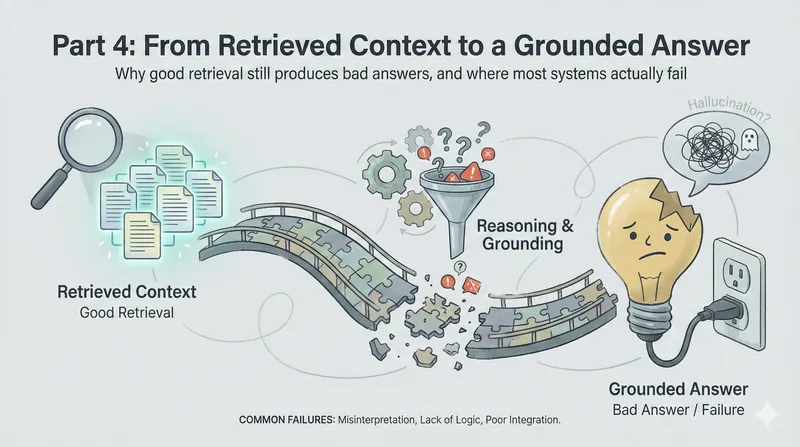 Part 4: From Retrieved Context to a Grounded AnswerJan 2026
Why good retrieval still produces bad answers, and where most systems actually fail
AI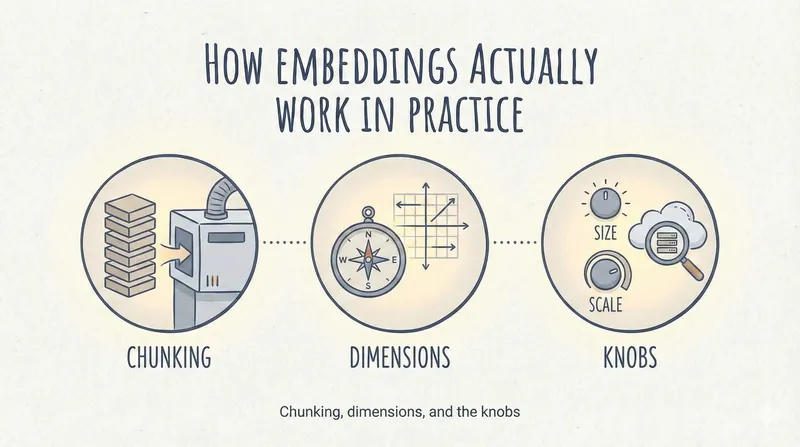 Part 2: How Embeddings Actually Work in PracticeJan 2026
Chunking, dimensions, and the knobs that decide whether retrieval works
AI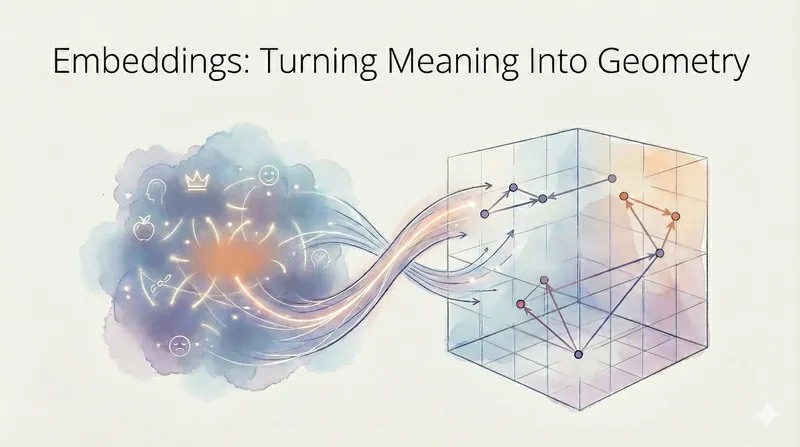 Embeddings: Turning Meaning Into GeometryJan 2026
A practical mental model for understanding embeddings, how they work, and why they matter for AI engineers
AI