Part 2: How Embeddings Actually Work in Practice
Chunking, dimensions, and the knobs that decide whether retrieval works
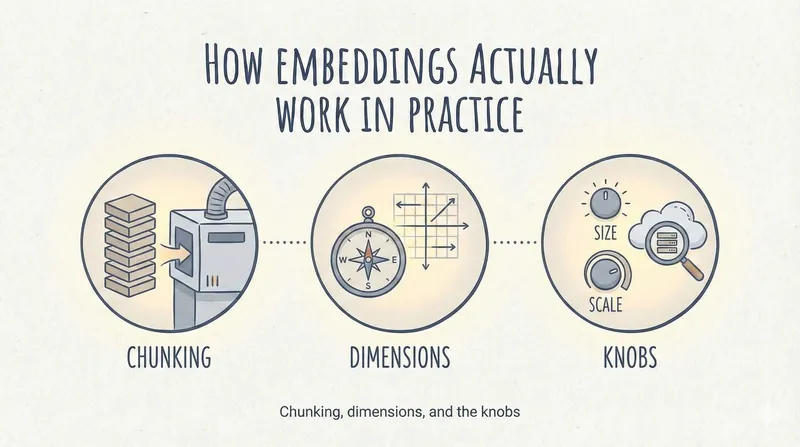
This is Part 2 of a 4-part series on embeddings. Part 1: Embeddings: Turning Meaning Into Geometry | Part 3: Retrieval Is Not Top-K | Part 4: From Retrieved Context to a Grounded Answer
Part 1 explained what embeddings are and why they exist.
This part explains how embeddings are actually used in real systems and why most problems come from configuration, not models.
If embeddings feel unreliable, vague, or inconsistent, the reason is almost always here.
The uncomfortable reality
Most embedding systems do not fail because:
- the model is weak
- the vector database is slow
- the dimension is "too small"
They fail because:
- meaning was broken before embedding
- too much meaning was compressed into too little space
- defaults were copied without understanding
Embeddings are simple. The pipeline around them is not.
Chunking is not preprocessing
It defines what your system can understand
A chunk is not "some text".
A chunk is the smallest unit of meaning your system is allowed to retrieve.
If an idea is split across chunks, your system cannot retrieve it as a whole. No model can fix that later.
This makes chunking a modeling decision, not a formatting step.
The most common chunking strategies (and when they work)
1. Fixed-size token chunking
Split text every N tokens with some overlap.
Typical values:
- 300 to 600 tokens
- 10–20% overlap
Why people use it
- easy
- predictable cost
- works on flat prose
Why it fails
- meaning ignores token boundaries
- rules get separated from conditions
- exceptions get detached from statements
This strategy is acceptable as a baseline, but rarely optimal.
2. Structure-aware chunking
Chunk by:
- headings
- paragraphs
- list blocks
- tables
This respects how documents already encode meaning.
Example: Instead of embedding isolated sentences, embed the full section under "Cancellation Policy".
This preserves:
- rules
- qualifiers
- exceptions
For policies, manuals, and documentation, this is often the biggest quality jump you can get.
3. Sliding window chunking
Use a moving window across text.
Example:
- window: 400 tokens
- step: 200 tokens
Each idea appears in multiple chunks.
What it improves
- recall
- boundary safety
What it costs
- more vectors
- more redundancy
- noisier top-k results
Sliding windows are brute-force insurance. Useful when missing information is worse than duplication.
4. Hierarchical (parent–child) chunking
Store:
- small chunks for retrieval
- larger parent chunks for context
Retrieve the child, then expand to the parent before generation.
This solves a core tradeoff:
- small chunks retrieve precisely
- large chunks contain complete answers
This pattern is extremely effective for long documents and complex questions, at the cost of added system complexity.
5. Contextual chunking
A chunk often depends on its surrounding context.
Instead of embedding raw text, prepend lightweight context:
- document title
- section path
- version or date
Example:
Document: Health Policy Section: Cancellation Text: Cancellation is allowed within 14 days…
This makes chunks self-contained without inflating them.
This is one of the highest leverage improvements in real systems.
Chunk size is not a magic number
It depends on your questions
Chunk size trades off precision and completeness.
| Chunk size | Behavior |
|---|---|
| Very small | Precise, but fragmented |
| Medium | Balanced, most common |
| Large | Context-rich, but vague |
A useful practical mapping:
| Query type | Chunking bias |
|---|---|
| "Where is X defined?" | smaller chunks |
| "What are the rules for X?" | section-sized chunks |
| "How do I do X?" | parent–child |
| "Compare A vs B" | summaries or hierarchy |
If your chunk does not contain the full idea, retrieval cannot succeed.
Dimensions: what they actually control
Embedding dimension controls representation capacity, not intelligence.
More dimensions mean:
- finer distinctions
- fewer semantic collisions
- higher cost and slower search
Less dimensions mean:
- stronger compression
- faster retrieval
- higher risk of different ideas collapsing together
The dimensions you actually see in practice today
Here is what real systems commonly use.
| Dimension | Why it exists |
|---|---|
| 384 | fast, lightweight, edge use |
| 512 | older sentence models |
| 768 | BERT-era standard, still common |
| 1024 | better separation, manageable cost |
| 1536 | very common modern default |
| 3072 | high-fidelity, expensive, niche |
768 persists mostly due to history, not because it is optimal.
It works well when:
- chunks are small
- ideas are narrow
- language is not extremely specialized
When 768 stops being enough
You usually see degradation when:
- chunks are large
- documents are legally or technically dense
- many clauses differ only slightly
- domain language is specialized
Examples:
- insurance endorsements
- legal exceptions
- compliance rules
- code search across similar functions
Here, higher dimensions reduce semantic collisions, not errors.
Chunk size and dimension must scale together
This interaction is widely ignored.
Think of it this way:
Chunk size decides how much meaning you pack in. Dimension decides how finely you can encode it.
A practical guide:
| Chunk size | Dimension range |
|---|---|
| 100–200 tokens | 384–768 |
| 300–600 tokens | 768–1536 |
| 800–1500 tokens | 1536+ or hierarchy |
| Full sections | parent–child |
If you pack a lot of meaning into a chunk but keep dimensions low, compression destroys distinctions.
Storage and cost math you should do once
Most embeddings use float32 vectors.
That is 4 bytes per dimension.
| Dimension | Size per vector |
|---|---|
| 768 | ~3 KB |
| 1024 | ~4 KB |
| 1536 | ~6 KB |
| 3072 | ~12 KB |
At scale, this dominates cost.
1 million chunks at 1536 dimensions:
- ~6 GB raw vectors
- plus index overhead
- plus metadata
- plus replication
Dimension choice is infrastructure, not theory.
Dimension reduction that actually works
Three approaches are common today.
1. Models that support dimension selection
Some modern embedding models allow you to choose output dimensions directly, preserving quality better than post-hoc reduction.
This is the cleanest option.
2. Matryoshka-style embeddings
These are trained so that:
- the first 256, 512, or 768 dimensions are meaningful
- additional dimensions add refinement
This lets systems:
- retrieve cheaply
- rerank with higher precision if needed
This pattern is increasingly common in large-scale systems.
3. PCA and projections
This can work, but quality drops unpredictably.
Use only if you measure carefully.
Overlap: what it really does
Overlap protects against boundary cuts.
It does not add intelligence.
| Overlap | When it makes sense |
|---|---|
| 5–10% | clean structure |
| 10–20% | narrative text |
| >25% | usually masking bad chunking |
If overlap is doing most of the work, your boundaries are wrong.
The part everyone forgets: search index tuning
Most vector search is approximate.
As dimension increases:
- search becomes harder
- recall drops if parameters stay fixed
Many teams blame embeddings when the real issue is insufficient search depth.
Always tune recall before switching models.
A sane default that rarely embarrasses you
If you need a starting point:
- structure-aware chunking
- 400–600 tokens per chunk
- 10% overlap
- contextual prefix (title + section)
- 768 or 1024 dimensions
- parent–child for long answers
Then evaluate on real queries.
Not benchmarks. Your users' questions.
(For more on embedding benchmarks and which ones matter, see Part 3.)
The mental model to keep
Embeddings are compression.
Chunking decides what you compress. Dimensions decide how much detail survives.
Most failures are compression mistakes, not model mistakes.
What comes next
Even with perfect chunking and dimensions, retrieval can still feel wrong.
Because relevance is not the same as usefulness.
The next logical step is retrieval dynamics:
- top-k limits
- redundancy
- diversity
- reranking
That is what Part 3 explores.
Previous: Part 1: Embeddings: Turning Meaning Into Geometry | Next: Part 3: Retrieval Is Not Top-K → Part 4: From Retrieved Context to a Grounded Answer
References and further reading
- LangChain, Text Splitters
- Pinecone, Chunking Strategies for LLM Applications
- Cohere, Embeddings: Dimensions and Distance Metrics
- OpenAI, Embeddings: Best Practices
- LlamaIndex, Chunking Best Practices
- Matryoshka Embeddings: Matryoshka Representation Learning
Related reading
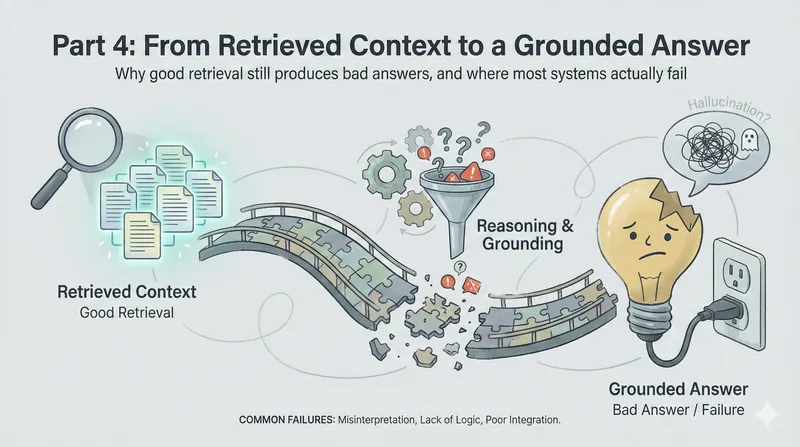 Part 4: From Retrieved Context to a Grounded AnswerJan 2026
Why good retrieval still produces bad answers, and where most systems actually fail
AI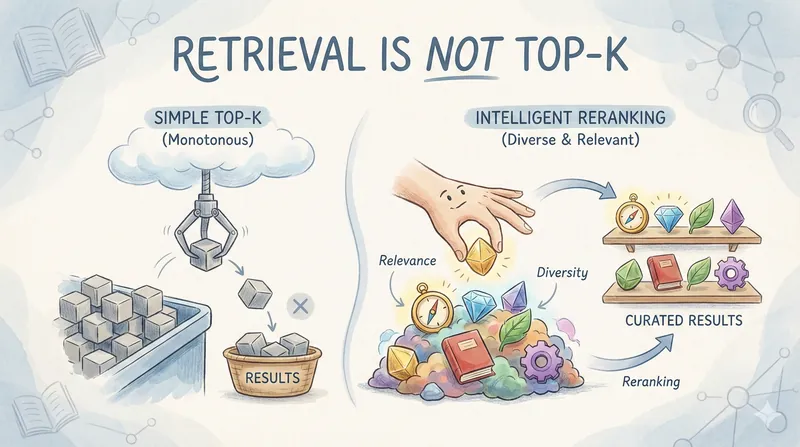 Part 3: Retrieval Is Not Top-KJan 2026
Relevance, diversity, reranking, and why most systems return the wrong things for the right reasons
AI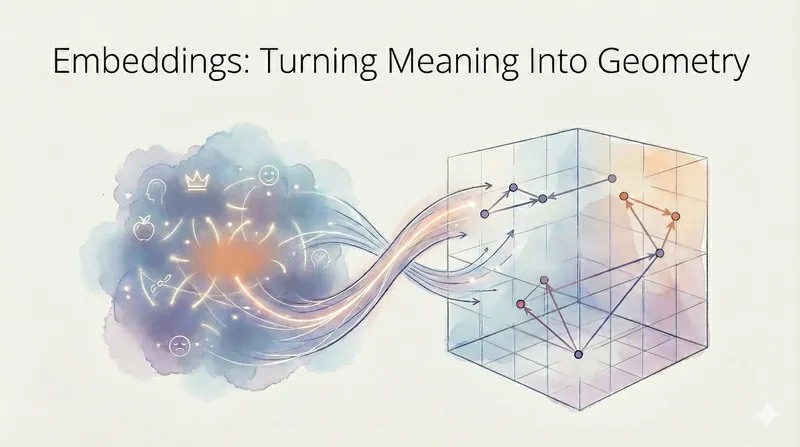 Embeddings: Turning Meaning Into GeometryJan 2026
A practical mental model for understanding embeddings, how they work, and why they matter for AI engineers
AI