The Yearly Review (Simple + Actually Useful)
A simple yearly self-review framework that's easy to do, easy to repeat, and easy to look back on later. No journal habit or fancy tracking required.
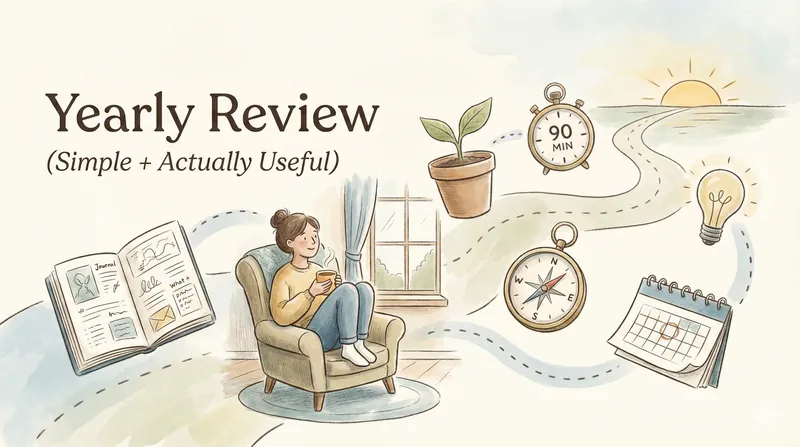
The Yearly Review (Simple + Actually Useful)
0) Prep (5 minutes): bring receipts
Open any 2–3 of these so you're not guessing:
- Calendar (events, trips, deadlines)
- Photos (camera roll)
- Notes / tasks (Notion, reminders, doc)
- Money snapshot (income, savings, big spends)
- Health snapshot (steps/gym/sleep if you track)
1) The Year in Moments (10 minutes)
Write 10–20 bullets of what happened. No essays. Just anchors.
Examples:
- "Moved cities"
- "Shipped X"
- "Broke up"
- "Big trip"
- "Got rejected/accepted for Y"
- "Started reading/gym"
- "Met someone important"
This becomes your timeline.
2) Score the Year (10 minutes)
Give each domain a 1–10 score, then write one line why.
Domains (use these or change based on your goals):
- Health
- Work/Craft
- Money
- Relationships
- Learning
- Fun/Adventure
- Mental state
Example: "Money: 6 — income good, but side income inconsistent."
3) Extract the Meaning (25 minutes)
Only answer these. Keep it short and blunt.
Wins (3)
- Win #1 → what caused it
- Win #2 → what caused it
- Win #3 → what caused it
Losses (3)
- Loss #1 → what caused it
- Loss #2 → what caused it
- Loss #3 → what caused it
Patterns (3)
Write as "When X, I tend to Y."
- Pattern #1
- Pattern #2
- Pattern #3
This is the whole point: you're converting memories into rules.
4) Pick Next Year's "3 Outcomes" (20 minutes)
Choose 3 outcomes max. If you pick 8, you'll do 0.
For each outcome, write:
- Outcome: what you want
- Metric: how you'll know it happened
- Lead metric (weekly): the actions that create it (things you control)
Example:
- Outcome: "$5k/mo side income"
- Metric: "3 months stable"
- Lead metric: "2 SEO pages/week + 1 conversion test/week + outreach"
5) Make It Real (20 minutes): WOOP + If-Then Plans
For each of the 3 outcomes:
WOOP (3 minutes each)
- Wish: what you want
- Outcome: what it looks/feels like
- Obstacle: what inside you blocks it (avoid vague "time")
- Plan: one if-then
If-Then Plans (2–3 per outcome)
Write these like switches:
- If it's Monday 10:30am, then I publish one page.
- If I feel like procrastinating, then I do 25 minutes of the smallest task.
- If I get a new idea, then I park it for 7 days.
6) Lock a Weekly Review (5 minutes)
Pick a fixed slot:
- Weekly review (20 min): Day/time: ________
3 questions:
- What moved?
- What stalled (and why)?
- What's next week's one move for each outcome?
That's it.
Template
Use the Notion template to complete your yearly review:
→ Open Yearly Review Template in Notion
Mini versions (so you can "review the year" anytime)
Monthly "keep the thread" review (15 minutes)
- 3 highlights
- 3 headaches
- 1 lesson
- 1 thing to repeat next month
- Update your 3 outcome lead metrics for next month
Mid-year review (45 minutes)
- Re-score the 7 domains (quick gut check)
- Wins so far (3) + losses so far (3)
- What goal is still real? What goal is fake now?
- Adjust the 3 outcomes (replace one if needed)
- Decide the next 6-week sprint (one focus)
Random-month "catch-up" review (30 minutes)
If you've ignored the system for months:
- Timeline: last 90 days in 10 bullets
- What's draining energy right now?
- What's the single most leverage outcome for next 6 weeks?
- Choose 2 lead metrics and do only those
Note: This is an ever-evolving framework—adjust things as they suit you. If you have a different framework or a better way, please share! I'd love to hear about it and incorporate improvements where possible.
References & Resources
Related reading
 My 2025: shipping, signal, and a few uncomfortable rulesJan 2026
A candid review of 2025 into 2026.
Personal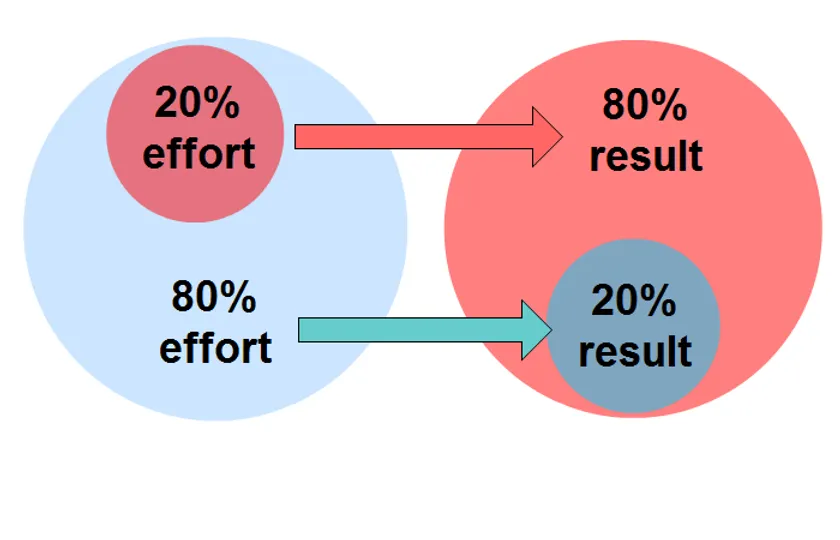 The 80/20 RuleMar 2024
The Pareto principle, and how to apply it to work and life instead of just quoting it.
Personal![Setting Up Mac for Development [May 2026]](/_next/image?url=%2Fcontent%2Fblogs%2Fmac-setup-2026.png&w=3840&q=75) Setting Up Mac for Development [May 2026]May 2026
Setting Up Mac for Development [May 2026]May 2026The current toolkit and the AI coding stack I'd put on a fresh Mac today. A year after my 2025 setup.
Engineering