Same model, different results across providers: routing, quant, fallbacks, wrappers (and a debugging checklist)
Why the same model name can behave differently across providers, covering routing layers, quantization differences, fallbacks, and hidden wrappers with a practical debugging checklist.
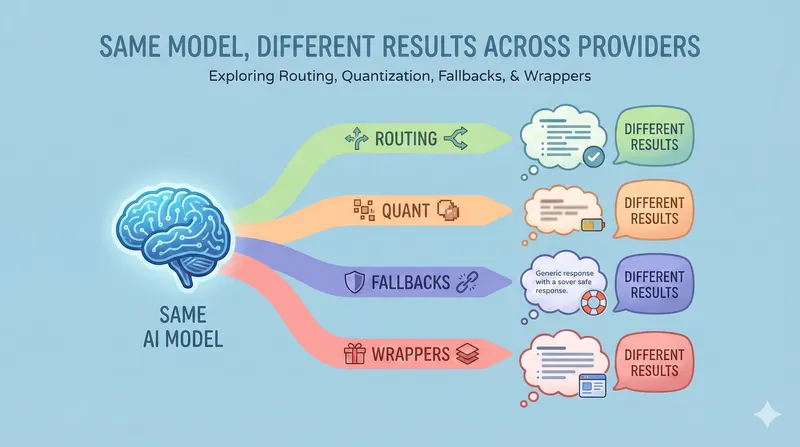
A practical guide to diagnosing "Provider A feels smarter than Provider B"
Developers run into this quickly:
- You call "Model X" on two providers
- The tone differs
- The reasoning differs
- Tool calling breaks on one but not the other
- You change nothing and it "gets worse" at peak hours
This is not superstition. It's architecture.
Here are the real causes you can actually act on.
1) If you're using a router, you might not be hitting the same backend
Routing platforms (example: OpenRouter) may route to different upstream providers based on cost/uptime/latency and can use fallbacks when errors occur. (OpenRouter)
OpenRouter documents:
- provider selection and disabling fallbacks for strict routing (OpenRouter)
- model fallback behavior and the kinds of errors that can trigger it (OpenRouter)
- debugging options to inspect the upstream request body they sent (OpenRouter)
If you don't lock routing during evaluation, you're not comparing models. You're comparing a moving target.
2) Providers may run different quantization levels or kernels
Even when the checkpoint is "the same model family," providers can serve it with different inference stacks:
- FP16 vs BF16 vs INT8
- weight-only INT4 vs W8A8 INT8
- different packing schemes and kernels
Quantization is a first-order lever for cost and throughput, and providers tune it. The same model label doesn't guarantee the same numerical execution.
If you're using OpenRouter specifically: their SDK docs include routing configuration and even mention filtering by quantization levels as part of provider selection parameters. (OpenRouter)
3) Hidden system prompts and policy wrappers can change behavior
Even with identical model weights, providers often wrap your request with:
- fixed system prompt prefixes
- safety policy reminders
- input filters
- tool use constraints
This can change style, refusals, verbosity, and even reasoning patterns.
Example: xAI's Grok model cards explicitly mention deploying with a fixed system prompt prefix and input filters in production API deployments. (data.x.ai)
So "same model" is not always "same prompt context."
4) Fallbacks can silently change what answered
There are two fallback types:
- Provider fallback: same model name, different provider
- Model fallback: different model altogether
OpenRouter's model fallback guide explains that any error can trigger fallback, including context validation errors, moderation flags, rate limits, and downtime. The final model used is returned in the response. (OpenRouter)
This is great for reliability, but bad for consistency unless you control it.
A tight debugging checklist (what to do when quality differs)
Step 1: Lock routing (or remove it)
If you can: disable fallbacks and explicitly specify provider order/only lists while evaluating. (OpenRouter)
Step 2: Standardize generation parameters
Fix temperature/top_p/max_tokens/etc. Small changes here can swamp provider differences.
Step 3: Build an "edge-case suite"
Test with prompts that expose precision/wrapper differences:
- strict JSON schema generation
- multi-step instruction following
- small arithmetic and constraint puzzles
- tool calls that must match a schema
Step 4: Inspect what was actually sent upstream
If your routing layer supports it, use debugging to confirm the transformed request body (e.g., OpenRouter debug option). (OpenRouter)
Step 5: Watch for quantization symptoms
Quantization-related degradation often looks like:
- occasional logical slips
- more constraint violations (format, schema)
- worse math reliability
- more variability between runs
The real takeaway
In production, "model quality" is not only weights + architecture.
It is also:
- routing and fallbacks
- quantization level and kernels
- hidden system prompts / policy wrappers
- provider-specific decoding defaults
If you treat "model name" as the whole contract, you'll keep getting surprised. If you treat "serving stack" as part of the model, debugging becomes straightforward.
Final thoughts
If you want consistency, your job is to reduce degrees of freedom:
- Pin your provider
- Pin quantization tier when possible
- Disable fallbacks during evaluation
- Standardize parameters
- Test on brittle prompts, not casual chat
References
- Intelligent Multi-Provider Request Routing - OpenRouter
- Model Fallbacks | Reliable AI with Automatic Failover - OpenRouter
- API Error Handling and Debugging - OpenRouter
- API Reference | OpenRouter SDK - OpenRouter
- Grok 4 Fast Model Card - xAI
Related reading
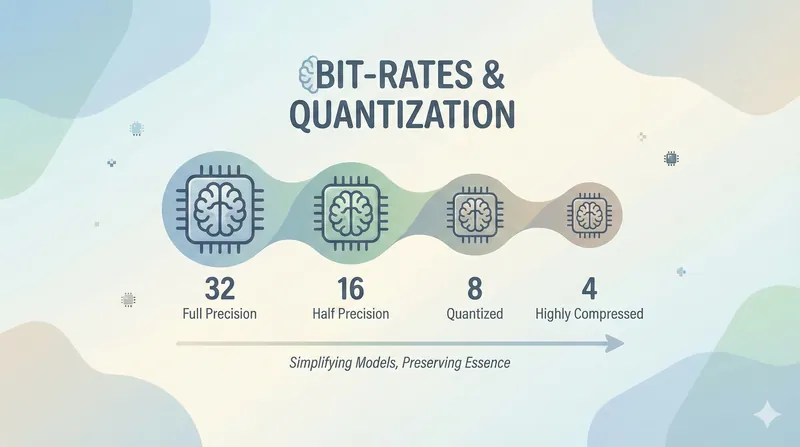 LLM Bit-Rates & Quantization: 32 vs 16 vs 8 vs 4 (what changes, what doesn't)Dec 2025
Understanding how bit-rates and quantization shape LLM deployment, from precision trade-offs to practical quantization methods like GPTQ, AWQ, and SmoothQuant.
AI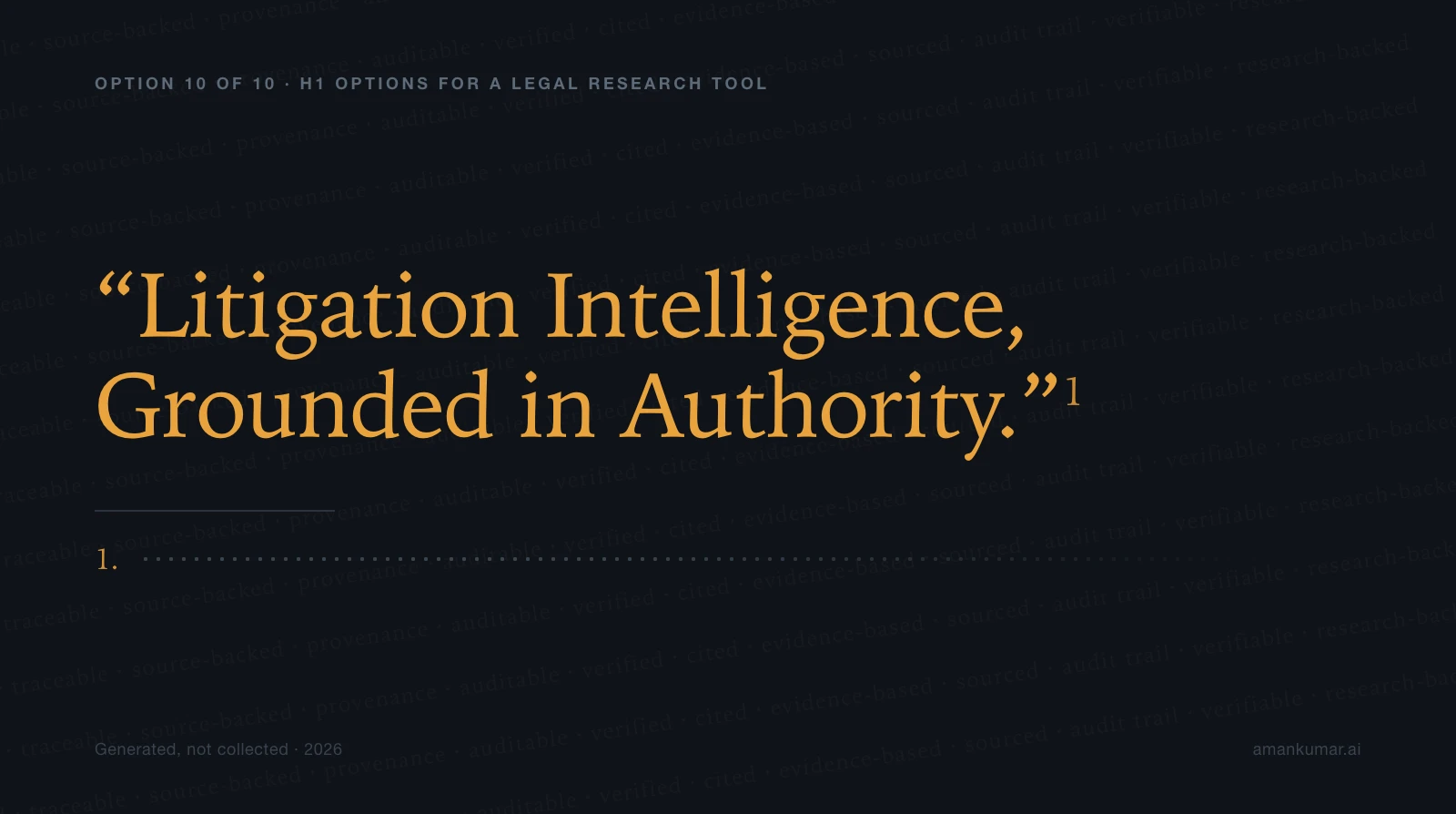 Why AI Keeps Writing "Source-Backed" Into Your CopyAug 2026
Ask a model for one headline and it never happens. Ask for ten options, which is what everyone actually does, and a quarter of analytical products hand you one about sources.
AI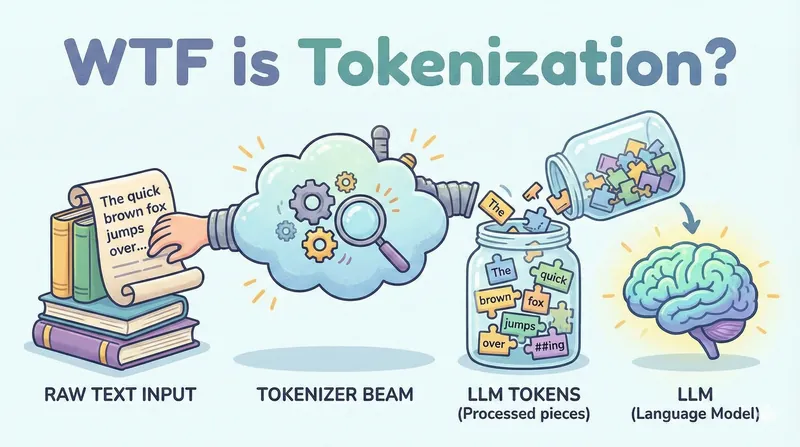 WTF is Tokenization?Dec 2025
Everything you need to know about how LLMs break text into tokens - and why it explains most of their weird behaviors.
AI