15 Golden Responses to "Tell Me About a Time You Failed"
Most candidates ruin their chances when asked about failure in interviews. These 15 scripted responses turn mistakes into masterclasses by focusing on recovery, lessons learned, and system changes.
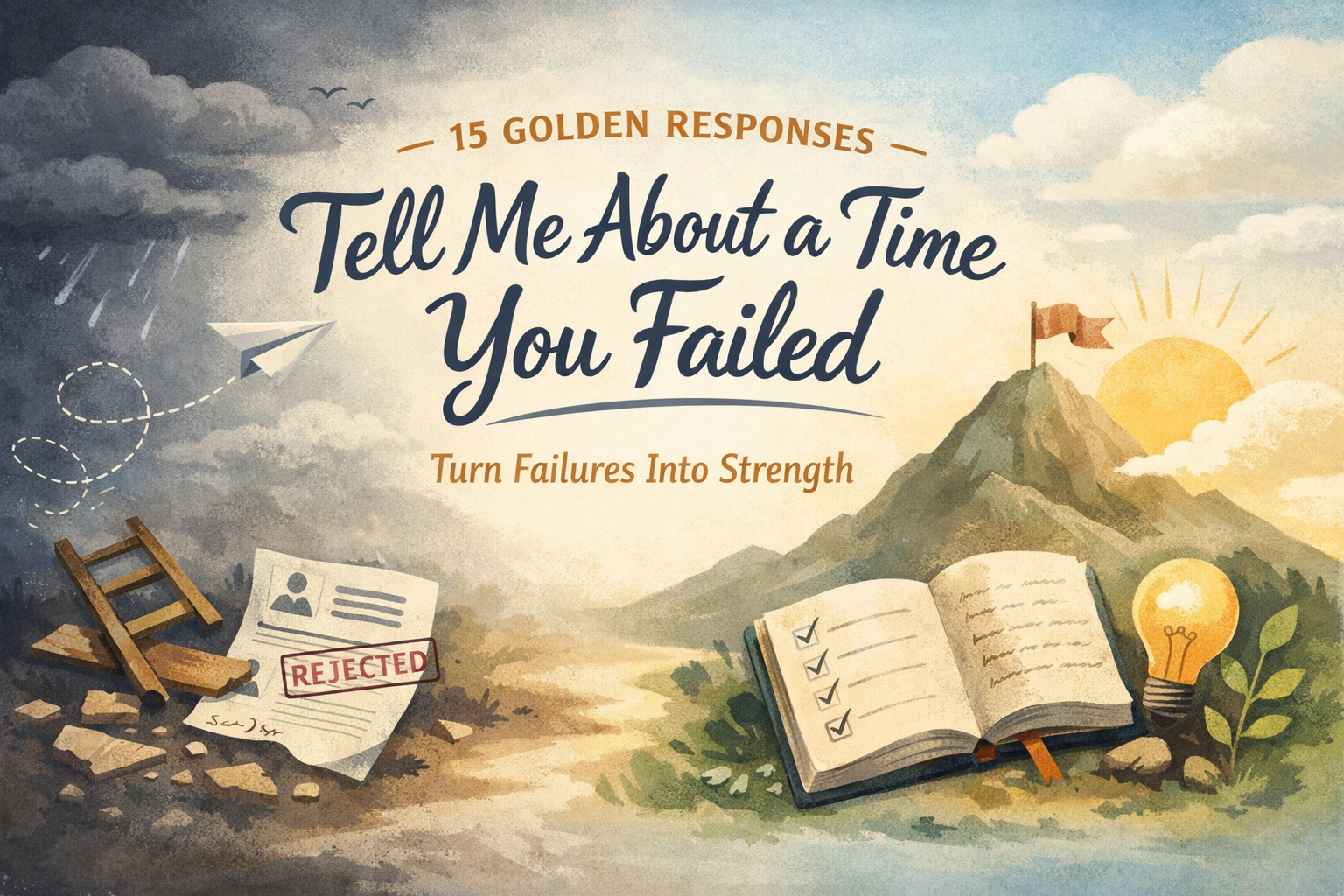
During a job interview, if they ask: "Tell me about a time you failed" — most candidates ruin their chances.
They say:
- "I work too hard." (Humblebrag)
- "I didn't double-check my code." (Careless)
- "I trusted the wrong person." (Blame shifter)
This question isn't about the failure. It's about the recovery.
Here are 15 scripts that turn a mistake into a masterclass:
1. The "Communication" Breakdown
"I once delayed a project because I assumed a requirement instead of clarifying it. I built the wrong feature. Since then, I've implemented a 'repeat-back' rule where I summarize requirements in writing before writing a single line of code."
Why it works:
- It admits a common error.
- It shows a system change.
- It proves you are now a better communicator.
2. The "Over-Engineering" Trap
"I spent two weeks building a perfect, scalable architecture for a feature that users didn't even want. I learned the hard way that 'perfect' is the enemy of 'shipped.' Now, I always build an MVP first to validate the hypothesis."
Why it works:
- Startups love this.
- It shows you value business impact over code purity.
- It frames failure as a lesson in lean development.
3. The "Deadline" Miss
"I underestimated the complexity of a 3rd party integration and missed a deadline by 3 days. I realized my optimism bias was a risk. Now, I always add a 20% buffer to my estimates and communicate delays weeks in advance, not days."
Why it works:
- It shows self-awareness.
- It addresses a universal engineer problem (estimation).
- It shows you are proactive about risk management.
4. The "Feedback" Resistance
"Early in my career, I got defensive during a code review. I took the critique personally. I realized that attitude stalled my growth. I actively worked on detaching my ego from my code, and now I'm the person who asks for the toughest reviews."
Why it works:
- It shows immense maturity.
- It tackles a major "culture fit" red flag.
- It proves you are coachable.
5. The "Production" Bug
"I deployed a hotfix on a Friday evening that took down a service for 15 minutes. It was a terrifying mistake. I didn't just fix the bug; I wrote a post-mortem and built a new CI/CD check to ensure that specific error class can never happen again."
Why it works:
- It's a war story.
- It shows you don't hide from fires.
- It emphasizes "systemic fixes" over "human error."
6. The "Prioritization" Fail
"I said 'yes' to too many stakeholder requests and ended up burning out and delivering average work on all of them. I learned that saying 'no' is a professional skill. I now use a prioritization matrix to focus only on high-impact tasks."
Why it works:
- It shows you can manage stakeholders.
- It frames you as someone who protects quality.
- It shows you learned boundaries.
7. The "Data" Blindspot
"I launched a feature based on intuition, and it flopped. I had zero data to back it up. That failure taught me to be data-informed. Now, I don't ship anything without defining success metrics and setting up analytics first."
Why it works:
- It positions you as a product-minded engineer.
- It shows you respect the market/user.
- It turns a flop into a strategic asset.
8. The "Delegation" Error
"When I first started leading, I micromanaged my team because I was afraid of quality drops. It slowed everyone down. I realized I was the bottleneck. I learned to trust, verify, and delegate outcomes rather than tasks."
Why it works:
- Essential for leadership roles.
- It admits a flaw that comes from caring too much.
- It shows you understand leverage.
9. The "Documentation" Debt
"I built a complex internal tool but didn't document it. When I went on vacation, the team was stuck. I felt terrible. I came back and spent a week writing full docs. Now, I treat documentation as a 'definition of done' for every ticket."
Why it works:
- Every team has this problem.
- It shows empathy for teammates.
- It proves you are a "force multiplier."
10. The "Testing" Gap
"I skipped writing unit tests for a 'simple' module to save time. It caused a regression two months later. I learned that skipping tests is essentially borrowing time from the future with high interest. I never skip them now."
Why it works:
- It validates your technical discipline.
- It uses a financial metaphor (interest) that managers understand.
- It shows long-term thinking.
11. The "Silence" Mistake
"I was stuck on a bug for two days and didn't ask for help because I didn't want to look incompetent. I wasted sprint time. I learned that 'timeboxing' is key. If I'm stuck for more than 60 minutes now, I ask for a pair programming session."
Why it works:
- It combats "imposter syndrome."
- It shows you value the team's time over your ego.
- It highlights collaboration.
12. The "Scope Creep" Victim
"I allowed a project's scope to expand without adjusting the timeline. We delivered late and stressed. I learned to be a guardian of the scope. Now, when requirements change, I immediately present the trade-offs: 'We can add X, but Y will be delayed.'"
Why it works:
- It shows project management skills.
- It proves you can have difficult conversations.
- It protects the team from burnout.
13. The "Quick Fix" Trap
"I applied a bandage solution to a recurring server issue instead of finding the root cause. It came back worse a month later. I learned the '5 Whys' technique and now I always dig until I find the foundational issue."
Why it works:
- It shows you are a deep thinker.
- It differentiates you from "patch-work" developers.
- It highlights problem-solving methodology.
14. The "Customer" Disconnect
"I built a feature exactly to spec, but the customer hated it because the spec didn't solve their actual problem. I failed to ask 'why.' Now, I try to understand the user's intent, not just the ticket's instructions."
Why it works:
- It shows customer obsession.
- It moves you from "coder" to "solver."
- It shows you care about the end result.
15. The "Hiring" Miss (For Managers)
"I hired a candidate based on skills alone, ignoring culture fit. It disrupted the team dynamic. I learned that skills can be taught, but attitude is harder to change. I've completely revamped my interview rubric to weigh values equally."
Why it works:
- It's a high-stakes failure.
- It shows you protect the team culture.
- It proves you learn from expensive mistakes.
The "Failure" Strategy Summary
- Pick a real failure (not a fake one).
- Keep the failure story short (10%).
- Focus on the lesson learned (40%).
- Focus on the system/habit change (50%).
They don't care that you fell. They care how you got back up.
Based on a thread by Katyayani Shukla (@aibytekat)
Related reading
 The Power of 1%: Habits for an Entrepreneur-EngineerJun 2025
Small daily, weekly, and monthly actions that compound into massive growth—tailored for founders and engineers.
Work High Agency: The Trait That Sets Top Performers ApartMay 2025
High-agency employees are rare but invaluable. Here's how to know if you're one—and how to become one.
Work Engineer vs EntrepreneurMay 2025
A short story and reflection on builders vs visionaries — and figuring out where you fall.
Work